The Telco Trap (Embracing MVNOs)
By Dr KH Asadul · Last reviewed 11 October 2026 · General information only, not personal advice
Why Australians overpay for NBN and mobile plans and how to embrace MVNOs.
The Telco Trap (Embracing MVNOs)
Take a look at your bank statement. If you are paying a lot each month for a single mobile plan, or a high price for home internet, you may be paying for a brand name you don't need. Many Australians stay with the big telco brands out of habit, and the habit can be expensive. This guide explains how mobile resellers (MVNOs) and NBN plans work, how to compare them properly, and how to switch safely. It is general information, not a recommendation of any provider.
Who Runs the Networks, and What Is an MVNO?
Moneysmart notes that the three major mobile networks in Australia are Telstra, Optus and Vodafone, and that each has different coverage (Moneysmart). An MVNO (Mobile Virtual Network Operator) is a provider that sells mobile plans using one of those host networks instead of building its own. Because it doesn't build its own network, it can often offer lower prices, though that depends on the provider and the plan.
The important question is whether the coverage is the same as the host's own premium plans. It may not be. A draft standard that the ACMA consulted on in early 2026 would require MVNOs to label which host network, "or variation thereof", their service uses, and it would give MVNOs a lighter obligation to publish coverage maps than the network operators themselves (ACMA consultation paper). The practical advice is to check the provider's coverage map and the network label for where you live, work and spend time before you switch. Moneysmart warns that black spots cause dropouts and poor call quality, and says not to sign up if you can't get service where you live and work.
How to Compare Mobile Plans
Moneysmart suggests comparing these points:
- The minimum total cost over the contract, including the phone if you are paying it off.
- Included data, and what extra data costs if you go over. SIM-only plans bill after the month, and going over your limit can mean large extra charges.
- Contract length: usually 12, 24 or 36 months for plans with a phone. Ending early may cost you extra fees.
- International calls, texts and roaming, which vary by country.
- The Critical Information Summary (CIS) for each plan. Download it and read it before you agree.
Comparison websites can help, but Moneysmart notes that they may earn money through promoted links and may not cover all options. Savings depend on your current plan, so work out the difference for your own situation instead of relying on a general figure.
Switching Without Losing Your Number
The ACMA explains how porting works (ACMA):
- Your current telco must port your number if you or your new telco asks. The new telco usually accepts but doesn't have to, so confirm before you sign up.
- The new telco organises the process. For a mobile, you need a new SIM.
- Mobile ports take about three hours.
- For mobile ports there is an extra identity check, such as a code sent by SMS, a verification call to your mobile, or identity documents.
- Your previous telco may charge a porting fee, and you must pay any final bills.
- Do not cancel your old service first. A disconnected number cannot be ported, and disconnected numbers are quarantined for 6 to 12 months, after which you lose your rights to them.
A Safe Switching Checklist
The ACMA also advises you to review your current contract first, since ending it early may carry a fee, to compare plans starting with each telco's Critical Information Summary, and to read the terms before signing, because you generally can't back out afterwards (ACMA).
- Check your contract and handset: do you owe repayments or exit fees? Missed repayments can affect your credit rating.
- Check coverage for the host network where you live, work and travel.
- Compare the total cost using each plan's Critical Information Summary.
- Confirm the new telco will accept your number before you sign.
- Complete the port and the identity check, and keep your old service active until it finishes.
- Check your account after the switch: you should receive a notice once the transfer is completed.
Protect Yourself From Scams
The ACMA says telcos must use at least two proofs of identity for high-risk requests such as moving a number or a SIM swap. Verification may be a unique code or a call to your number, which helps stop scams. Never share a verification code with someone who contacts you out of the blue, and verify a telco's identity before sharing personal details.
The NBN: Not All Plans Are the Same
The NBN is a wholesale network, so different retail providers sell plans over the same underlying infrastructure. But that does not mean every plan performs the same. The ACCC says advertised home broadband speeds must be accurate and must not create a false impression, and that some providers have misled customers by advertising maximum speeds that users can't actually reach (ACCC).
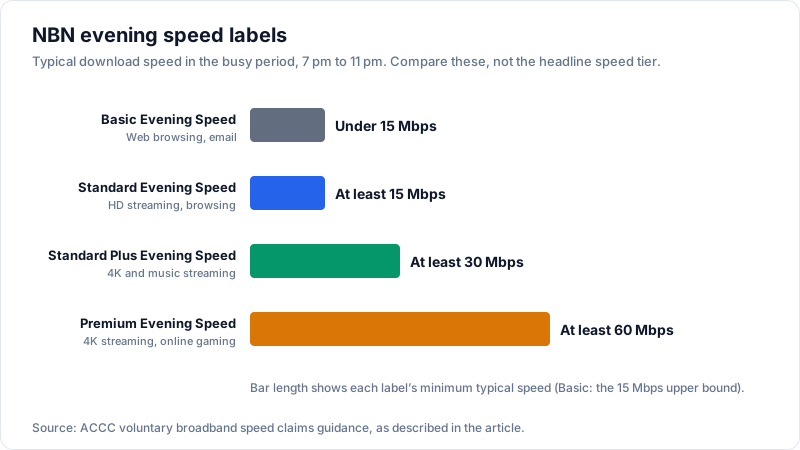
The ACCC's voluntary guidance asks providers to advertise each NBN plan's typical speed during the busy evening period, 7 pm to 11 pm, using four labels:
| Label | Typical evening download speed | Typical use |
|---|---|---|
| Basic Evening Speed | Under 15 Mbps | Web browsing, email |
| Standard Evening Speed | At least 15 Mbps | HD streaming, browsing |
| Standard Plus Evening Speed | At least 30 Mbps | 4K and music streaming |
| Premium Evening Speed | At least 60 Mbps | 4K streaming, online gaming |
Compare plans using these labels instead of the headline speed tier. The ACCC's Measuring Broadband Australia monitoring program concluded in June 2026, and its performance data and reports remain available for comparing providers. If you have been misled, contact your provider first, then the Telecommunications Industry Ombudsman.
Note: speed labels and program details are as at 11 October 2026 and can change.
Next Steps: We have now covered the major leaks in everyday cash flow: energy, phone and internet, and general insurance. But what happens to your wealth if you suddenly cannot work? Life, TPD and Income Protection Insurance covers that.