First Home Super Saver (FHSS) Scheme Explained
By Dr KH Asadul · Last reviewed 11 October 2026 · General information only, not personal advice
Saving for a house deposit is the hardest part of buying a home. If you save money in a standard bank account, you are saving with your "after-tax" money. If you earn $90,000 a year, the government taxes a large chunk of your income, and you can only save what is left over.
First Home Super Saver (FHSS) Scheme Explained
The First Home Super Saver (FHSS) scheme lets you put extra voluntary contributions into your super fund and later ask the ATO to release them, plus an amount of associated earnings, to help buy your first home. The aim is to take advantage of super's tax treatment. This article explains how it works as at 11 October 2026, with a worked example, the rules to check, and the timing traps.
Why It Can Help
Voluntary concessional contributions, such as salary sacrifice, are taxed at 15% in the fund. The ATO notes this is usually less than your marginal income tax rate. When you take the money out for a home, the assessable part is taxed at your marginal rate, with a 30% FHSS tax offset (ATO).
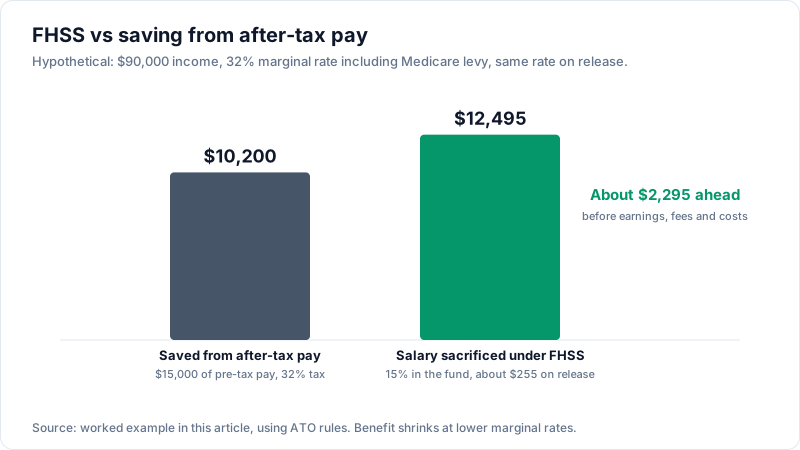
Here is a hypothetical example. Your income is $90,000, so your marginal rate is 30% plus the 2% Medicare levy, or 32% (ATO). You arrange to salary sacrifice $15,000 of pre-tax pay.
| Step | Saving from after-tax pay | Using the FHSS scheme |
|---|---|---|
| Starting amount | $15,000 of pre-tax pay | $15,000 of pre-tax pay |
| Tax paid on the way in | 32% = $4,800 | 15% in the fund = $2,250 |
| Amount that goes to your savings | $10,200 | $12,750 |
| Tax on release | None | 32% less the 30% offset = 2%, about $255 |
| Amount available | $10,200 | about $12,495 |
On these assumptions the scheme leaves you about $2,295 ahead, before any earnings. The example assumes your marginal rate is the same when you contribute and when you release, and it leaves out fees and your fund's costs. If your marginal rate is low, the benefit shrinks or disappears, because the fund already takes 15%.
What You Can Release
The ATO sets these limits and release rules (ATO, ATO):
- Limits. Eligible contributions count up to $15,000 in any one financial year and $50,000 in total.
- What counts. Voluntary contributions only. Your employer's compulsory super guarantee payments are not eligible.
- Release percentage. Non-concessional personal contributions that you don't claim as a deduction can be released at 100%. Concessional contributions, including salary sacrifice, can be released at 85%, because the fund has already taken 15% tax.
- Contribution caps. The ATO's guidance says contributions that exceed your contributions caps are not eligible for release. Check the current concessional and non-concessional caps before you plan, because these counts also apply to your other super contributions.
- Order. Contributions are counted first-in, first-out.
"Associated Earnings" Are Not Your Fund's Returns
The ATO says associated earnings are a notional amount calculated at the shortfall interest charge rate. They do not reflect what your fund actually earned or lost. The ATO lists that rate as 7.43% (July to September 2026) and 7.51% (October to December 2026) (ATO).
The ATO's worked example shows the idea: $50,000 of concessional contributions releases at 85%, or $42,500, plus $5,190 of associated earnings, for a maximum release amount of $47,690. Your own figure depends on when you contributed.
Who Can Use It
The ATO says all of these must be true (ATO):
- You are 18 or over when you request a FHSS determination. Contributions made before you turned 18 can count.
- You are a first home buyer who has never owned property in Australia. You may still qualify if the ATO determines you suffered FHSS financial hardship.
- You have no completed release request from an earlier FHSS determination.
Eligibility is assessed individually. Partners, siblings or friends can each use their own contributions to buy the same property, and one person's ownership history doesn't affect another's. For a couple who both qualify, the combined maximum is $100,000, but that assumes each contributes the full amount.
You must also intend to live in the home. The ATO's guidance note says that means at least 6 of the first 12 months it is practicable for you to occupy it (ATO).
Steps and Timing
- Request a FHSS determination to find out how much you can release. This must be done before you sign a contract and before ownership of a property transfers to you.
- Request the release of your FHSS amount plus associated earnings.
- Buy or build. The ATO guidance note says that for determinations made on or after 15 September 2024, the window to sign a contract opens 90 days before your release request and ends 12 months after it, and it can be extended by up to 12 more months.
- If you don't buy, you can recontribute the amount as a non-concessional contribution, which counts toward your non-concessional cap, or pay FHSS tax. Once recontributed, it can't be released under the scheme again.
Timing rules were different for earlier determinations, so use the ATO's current guidance for your own case.
Risks and Costs
- Market risk. Your contributions sit in a super fund and their value can move up or down while you save. The released amount is calculated by the ATO, so your fund's actual result will differ from it.
- Fees and insurance. Check your fund's fees and any insurance before adding money for a short period.
- Timing and paperwork. Missing the determination step or the contract window can change the tax outcome.
- Tax rate changes. Marginal rates change, and the benefit depends on your income in the year you contribute and the year you release.
A registered tax agent or licensed adviser can look at your own numbers.
Next Steps
Use the calculator below with your income and contribution to estimate the tax advantage, then check the ATO's current eligibility and release pages. If you are also looking at the government's deposit schemes, our article on the 5% Deposit Scheme and lenders mortgage insurance covers those.
These details are as at 11 October 2026. Rates, caps and rules change, so check the ATO pages linked above before you act. This is general information, not tax or financial advice.
🏠 FHSS Tax Benefit Calculator
See how much faster your house deposit grows by using the First Home Super Saver Scheme.
Your estimated marginal tax rate (inc. Medicare) is 32.0%.
Maximum $15,000 per financial year.
How the math works:
- If taken as normal pay, the ATO taxes your $15,000 at 32.0%.
- If sent to Super, the ATO taxes it at 15%.
- When withdrawing for a house, the assessable part is taxed at your marginal rate, less the 30% FHSS tax offset. Only 85% of concessional contributions can be released.
On these assumptions the scheme leaves about $2,295.00 more for your deposit from tax alone. This is an estimate: it leaves out associated earnings, fund fees and costs, contribution caps, and any change in your income or tax rates.