Subscription Creep (The Digital Audit)
By Dr KH Asadul · Last reviewed 11 October 2026 · General information only, not personal advice
How small, automated $15/month charges destroy wealth compounding.
Subscription Creep (The Digital Audit)
You have looked at your insurance, your super and your phone plan. Those are big, high-impact moves. But there is a quieter leak in everyday cash flow: subscription creep.
Subscription creep happens when small recurring charges, such as $9.99 here and $15.99 there, quietly add up. Because the payments are automatic and each one looks small, they can feel like "access" and not like an expense.
How Big Is It?
Two Australian surveys give a sense of the scale. Both are industry or commercial research, so treat the figures as indicative and not official statistics.
- ING (April 2026): ING estimates Australians spend about $26.5 billion a year on discretionary subscriptions. It found 78% of Australians pay for at least one subscription, and that subscribers spend an average of $136 a month, or $1,637 a year. The survey covered 2,045 Australians aged 18 and over, taken between 26 February and 11 March 2026 (ING).
- Compare the Market (June 2026): A survey of 1,015 Australians, run by Pureprofile in March 2026, found 50% pay for subscriptions they don't use. Gym memberships were cited by 27% of respondents and averaged $93 a month ($1,116 a year), the largest single cost. Netflix was the most-cited unused service (57%), followed by Disney+, Amazon Prime and Spotify. Compare the Market estimates the top five unused subscriptions can cost up to $1,667.52 a year at base prices (Compare the Market).
What the Wasted Money Could Do
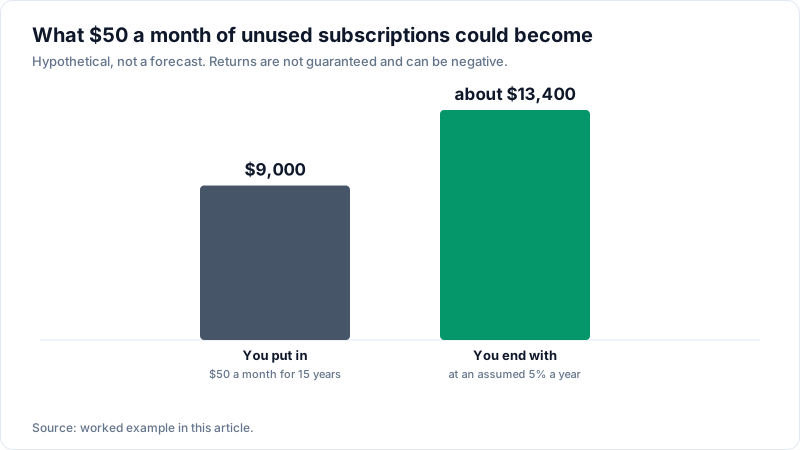
Here is a hypothetical example, not a forecast. If you cancelled $50 a month of subscriptions you don't use and invested that amount at an assumed 5% a year for 15 years, you would have put in $9,000 and ended with about $13,400. Returns are not guaranteed and can be negative, but the point stands: small recurring amounts add up whichever way they go.
How to Run a Digital Audit
Moneysmart's advice is to review where your money goes, watch for subscriptions you no longer use, and look at reducing wants first (Moneysmart). Audit every three to six months. Here is a 15-minute process:
- Gather the evidence. Pull up your last 60 to 90 days of bank and credit card statements. Open the subscription settings in your Apple and Google Play accounts. Look for every recurring charge, including quarterly and yearly ones.
- Run the "sign-up today" test. For each service ask: "If I didn't already have this, would I sign up for it at this price today?" If the answer is no, or even "maybe", cancel it.
- Rate each one: keep, cut or pause. The table below helps.
- Check for overlaps. Are you paying for Amazon Prime for delivery and also paying separately for a video service it includes? Does your phone plan or bank include a subscription you also pay for elsewhere?
- Try "pause and rotate" for streaming. You rarely need every service at once. Keep one, watch what you want, then cancel and move to another the next month. This is a personal tip and not a rule, and you should check each service's cancellation terms first.
| Subscription | Cost per month | Used in last 30 days? | Keep / Cut / Pause |
|---|---|---|---|
| Example: gym membership | $93 | No | Cut |
| Example: streaming service | $9.99 | Yes | Keep |
Making the Cancellation Stick
Some businesses make cancelling harder than signing up. The Treasury minister said in January 2026 that three in four Australians with subscriptions report trouble cancelling (Treasury). Practical steps:
- Keep the confirmation: screenshot the cancellation screen and save the confirmation email.
- Check your next statement to confirm the charge has stopped.
- If you pay by direct debit, you can contact your bank and tell them when you want the payments to stop. Ask for a letter confirming your request. Once the bank receives it, it must stop the payments and forward your cancellation to the provider's bank (Moneysmart).
- If you pay by recurring credit card payment, contact the provider first, then your bank.
- If direct debit is a condition of the contract, consider getting legal advice before cancelling, and if you still owe money you will need to agree another way to pay.
- If a debit comes out after you cancelled, contact your bank as soon as possible.
New Rules on Subscription Traps
The federal Government has legislated against subscription traps. The Competition and Consumer Amendment (Unfair Trading Practices) Bill 2026 was introduced on 1 April 2026 and, according to media reports, passed Parliament in July 2026 (Treasury). The reforms are due to commence on 1 July 2027. According to the Parliamentary Library, the subscription provisions require suppliers to disclose key information when making the offer, send notices before a free trial ends, before renewal and when prices change, and make every method of cancelling easy to find and straightforward (Parliamentary Library). The ACCC is responsible for enforcement, and the maximum penalties are $100 million.
Note: this is as at 11 October 2026. These rules do not apply until 1 July 2027, and details may change, so check Treasury or the ACCC for the current position.
Next Steps: You have now plugged the digital leaks in your budget. The final piece of the protection puzzle is making sure a sudden financial shock does not push you into high-interest debt. The Emergency Fund looks at how to build one.
Sources and further reading
- ING Australia: subscription research (24 April 2026)
- Compare the Market: Wasted subscriptions 2026
- Moneysmart (ASIC): Track your spending
- Moneysmart (ASIC): Direct debits
- Treasury minister: Banning unfair trading tricks and traps (1 April 2026)
- Treasury minister: New Year's resolutions shouldn't come with a cancellation nightmare
- Parliamentary Library: Competition and Consumer Amendment (Unfair Trading Practices) Bill 2026