Navigating the 2026 Health Insurance Hikes
By Dr KH Asadul · Last reviewed 23 October 2026 · General information only, not personal advice
How the 4.41% April 2026 health premium rise was approved, what to check at renewal, how the Medicare Levy Surcharge works, and Moneysmart guidance for home, contents and car insurance.
Navigating the 2026 Health Insurance Hikes
Insurance is meant to protect your finances from large, unexpected costs, but the premiums themselves can strain a budget. This article explains how private health insurance premium rises are approved each year, what you can check at renewal, how the Medicare Levy Surcharge (MLS) fits in, and what Moneysmart advises about comparing home, contents and car insurance. It is general information as at 23 October 2026, not personal advice.
How Health Premium Increases Work
Private health insurers apply to the Minister for Health once a year in the annual premium round. The Minister must approve an application unless satisfied the increase is not in the public interest, and approved increases take effect on 1 April each year (Department of Health).
For 2026, the Government approved an industry average increase of 4.41% from 1 April, compared with 3.73% the year before. The Minister's release says each insurer's average change is published on health.gov.au, and that insurers must explain the reasons for changes and your options (Minister for Health).
The average hides differences between funds and between policies. As a hypothetical, a policy costing $2,400 a year would rise by about $106 at exactly the average, but your own increase is shown on your renewal notice. Insurers must give notice early enough for you to review your cover and consider switching.
What You Can Check at Renewal
Compare policies
The Commonwealth Ombudsman runs PrivateHealth.gov.au, which describes itself as independent information and lets you compare policies and insurers. The Minister's release encourages people to review their needs and use it to compare products and prices from all insurers (PrivateHealth.gov.au).
Paying in advance
The Department of Health says some insurers offer "rate protection" to customers who pay in advance. With it, an increase during the prepaid period does not apply until that period ends. Without it, the insurer may ask you to pay the difference at the new rates or shorten the period your advance payment covers. This is not guaranteed, so ask your insurer in writing whether your prepayment is rate-protected before paying.
Changing the level of cover
A cheaper policy generally covers fewer services or carries a higher excess. Before downgrading, compare what is excluded and whether any waiting periods apply to services you might need. This article could not verify the detail of every cover tier, so use the policy documents and PrivateHealth.gov.au to confirm.
The Medicare Levy Surcharge
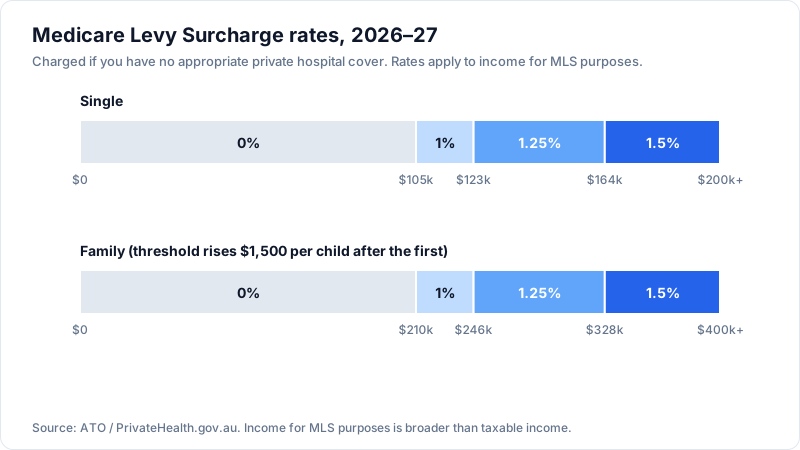
PrivateHealth.gov.au explains that taxpayers without private hospital cover who earn above the income threshold pay the MLS on top of the 2% Medicare levy. It covers you and your dependants. The 2026–27 thresholds and rates are:
| Status | Income for MLS purposes | Surcharge |
|---|---|---|
| Single | Up to $105,000 | 0% |
| Single | $105,001 to $123,000 | 1.0% |
| Single | $123,001 to $164,000 | 1.25% |
| Single | Above $164,000 | 1.5% |
| Family | Up to $210,000 | 0% |
| Family | $210,001 to $246,000 | 1.0% |
| Family | $246,001 to $328,000 | 1.25% |
| Family | Above $328,000 | 1.5% |
Source: PrivateHealth.gov.au. The family thresholds rise by $1,500 for each dependent child after the first.
To avoid the surcharge, you need approved hospital cover with a registered insurer for you and all dependants, with a maximum yearly excess of $750 for singles and $1,500 for families. Extras-only cover does not count, and days without cover are charged. As a hypothetical, a single person with MLS income of $120,000 and no hospital cover would pay 1% of that income, or $1,200, in surcharge. That figure is one input into the decision, not a recommendation to buy cover.
Home, Contents and Car Insurance
Moneysmart's guidance for general insurance is consistent across its car and home pages:
- Compare before renewing. Staying with your current insurer may cost more. Comparison websites are usually paid by insurers and may not show every product, so check more than one source (Moneysmart: car insurance).
- Cheaper is not always better. Check the sum insured, the excess, the exclusions, and the Key Fact Sheet, which insurers must provide so policies can be compared side by side. Review your sum insured if you have renovated or not checked in 12 months (Moneysmart: home insurance).
- Ask your insurer. Moneysmart reports that about 31% of customers who asked got a lower premium without reducing cover. Ask whether they can match a quote and whether you are getting all eligible discounts.
- Pay annually if you can. Paying by instalments can cost 10–20% more over the year.
Loyalty Pricing
ASIC has alleged in court that two IAG subsidiaries misled home insurance customers about loyalty discounts under the SGIO, SGIC and RACV brands, with premium increases possibly applied before discounts. The alleged conduct covers 25 August 2017 to 24 August 2023. ASIC's liability hearing concluded on 1 May 2026 and judgment is reserved, so there is no finding yet (ASIC). It is an allegation about one group, not proof of how all insurers price.
Checklist
- Read your renewal notice and note the increase and the new premium.
- Check your insurer's average change on health.gov.au and compare policies on PrivateHealth.gov.au.
- Before paying in advance, confirm in writing that rate protection applies.
- If you are near an MLS threshold, check that hospital cover and excess meet the rules for you and every dependant.
- At renewal for home, contents and car, compare like with like on sum insured, excess and exclusions, not just price.
- Ask your insurer to match a quote, and pay annually if affordable.
Next Steps
Use the calculator below to compare premiums on your own numbers, entering the excess for each quote. Then confirm the policy details before you switch or downgrade.
🛡️ Household Insurance Premium Comparison
Compare your current premiums with quotes for the same level of cover. The starting figures are illustrative. Enter the excess too, because a lower premium with a higher excess is not a like-for-like saving.
Estimated Annual Premium Difference
On these inputs the quotes cost about this much less per year than your current premiums.
This compares premiums only. Check the sum insured, exclusions, waiting periods (health) and the Key Fact Sheet before switching. Paying monthly can cost more than paying annually, per Moneysmart. For health cover, keep approved hospital cover and the excess limits in mind if you want to avoid the Medicare Levy Surcharge. General information, not personal advice.
Sources and further reading
- Minister for Health: 2026 private health insurance premiums
- Department of Health: Apply to increase private health insurance premiums
- PrivateHealth.gov.au (Commonwealth Ombudsman)
- PrivateHealth.gov.au: Medicare Levy Surcharge
- Moneysmart: How to save money on car insurance
- Moneysmart: Choosing home insurance
- ASIC: 23-228MR ASIC alleges IAG misled home insurance customers on pricing discounts