How to Run the Numbers Like a Professional Property Investor
By Dr KH Asadul · Last reviewed 11 October 2026 · General information only, not personal advice
To determine if a property will actually build your wealth—or just drain your salary—you must evaluate it across its entire lifecycle.
How to Run the Numbers Like a Professional Property Investor
The most common mistake new property investors make is relying on "napkin math". They look at the weekly rent, subtract the estimated mortgage payment, and assume the leftover amount is their profit.
In practice, profitability is shaped by buying costs, running costs, tax and the cost of debt over time. A property that looks like a cash cow on a listing can become a drain on your salary if you ignore vacancy periods, maintenance and interest rate changes. This guide is general information about how to assess an investment property, and it is not a recommendation to buy one.
The Four Pillars of Property Assessment
Before you sign a contract of sale, stress-test the property against these four pillars.
1. The True Acquisition Cost (The Entry Barrier) Getting the keys costs much more than the deposit. Moneysmart lists the costs of buying as stamp duty, conveyancing, legal fees, searches, and pest and building reports. In its example, a $550,000 unit came with $23,000 in buying costs. Stamp duty varies by state, so get a quote for the property you are considering. These costs determine how much cash you need on day one.
2. The Operational Ledger (Cash Flow Reality) Your rent has to cover more than the loan. Moneysmart lists the costs of owning as council and water rates, building and landlord insurance, body corporate (strata) fees, land tax, property management fees, and repairs and maintenance. It also warns that vacancies may leave you covering costs yourself, and that you should not rely on rent to cover your mortgage.
3. Loan Acceleration (The Cost of Money) How long do you intend to hold the debt? Loans are commonly written for 30 years, but paying one off faster changes your monthly cash needs and your total interest. Moneysmart notes that mortgage payments are due whether or not the property has a tenant, and that interest-only loans see repayments rise once the interest-only period ends.
4. The Wealth Horizon (Capital Growth vs. Total Cost) Rent pays some of the bills, but investors usually hope for capital growth. To estimate your profit, project the property's future value over your holding period and subtract everything it cost you to hold: your deposit, your buying costs, your ongoing shortfalls, and your selling costs and tax. Growth is not guaranteed, and Moneysmart warns that you could owe more than the property is worth.
A Worked Example
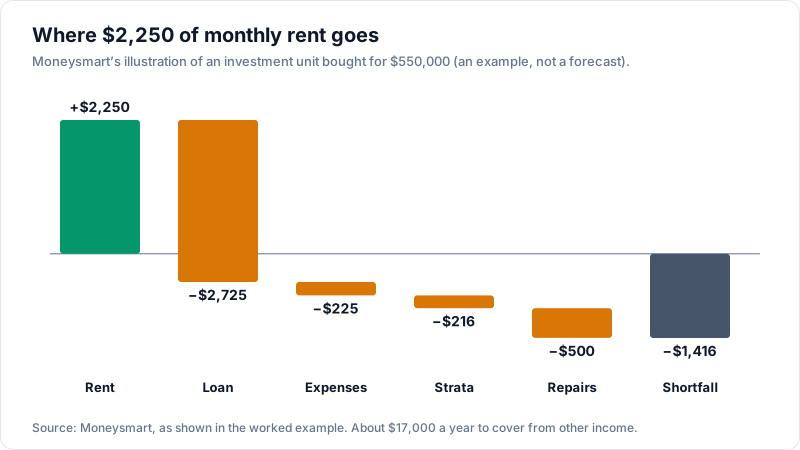
Moneysmart gives this illustration of an investment unit (the figures are its example, not a forecast):
| Monthly item | Amount |
|---|---|
| Rent | +$2,250 |
| Loan repayment | −$2,725 |
| Expenses | −$225 |
| Strata | −$216 |
| Repairs | −$500 |
| Monthly shortfall | −$1,416 |
That is about $17,000 a year that the owners have to cover from their salary and savings. The rent of $27,000 a year on a $550,000 price is a gross yield of about 4.9% before any costs (our calculation, not Moneysmart's). The yield looks reasonable, yet the property still runs at a loss once the loan and costs are included.
Stress-Test the Loan
Moneysmart suggests checking whether you could still afford repayments if interest rates rose by 2% or 4%. As a rough illustration on a $423,000 loan, a 2 percentage point rise adds about $8,460 a year in interest, or about $705 a month. This is approximate, since it ignores principal repayments and your lender's actual rate. Ask your lender or broker for the repayment at each higher rate.
What Tax Does to the Numbers
Deductions. The ATO says rental deductions require the property to be rented out or available to rent on commercial terms, and it covers common property expenses, repairs and maintenance, capital expenses and borrowing expenses on separate pages. Which of your costs you can claim, and when, depends on the item, so keep records and ask a registered tax agent.
The 2027 reforms. The ATO says the Government's negative gearing and capital gains tax measures, announced in the 2026–27 Budget on 12 May 2026, are now law and start on 1 July 2027. According to the Budget explainer:
- Negative gearing: losses on residential property can offset only other residential property income, including capital gains, and no longer salary or wages. Losses on existing properties bought after the announcement carry forward. Eligible new builds keep negative gearing.
- Grandfathering: properties held at the announcement (7:30pm AEST, 12 May 2026), including those under contract but not yet settled, keep full negative gearing until sold. Properties bought between the announcement and 30 June 2027 keep it until 30 June 2027 only.
- Capital gains: the 50% discount is replaced by cost base indexation plus a 30% minimum tax on gains accruing after 1 July 2027. For assets bought before that date, gains up to 1 July 2027 keep the 50% discount.
These rules change the "Wealth Horizon" calculation, especially for established properties bought now. The Budget explainer shows the outcome varies with the return: a lower return can mean less tax, and a higher one more.
Note: this is correct as at 11 October 2026. Rules and definitions (for example, what counts as a new build) can change or be clarified, so check the ATO's tax reform page before you decide.
The Risks Moneysmart Wants You to Weigh
- Vacancy: you may need to cover all costs with no rent coming in.
- Interest rates: rises mean higher repayments and less disposable income.
- Concentration: holding only property puts your money in one market.
- Liquidity: you cannot sell a bedroom if you need cash quickly, and exit costs are high.
- Gearing: borrowing magnifies losses as well as gains. You must repay the loan and interest even if the investment falls, and some lenders accept your home as security.
Questions to Ask Before You Buy
- Does my budget cover the shortfall for the long term, and could I cover every cost if I had no tenant for a while?
- Is the area high growth with good rental yield and low vacancy?
- What are the likely maintenance costs for this property's age and type?
- Am I being steered by advisers who recommend each other's services? Moneysmart says to be wary of that.
- Does this property fit with how my other investments are spread?
Use the Investment Viability Assessor
The tool below lets you enter a property's purchase price, rental income and expected expenses. Adjust the sliders on the left to match your scenario, and the ledger on the right calculates your total initial outlay, your weekly cash flow and your projected final profit. It is a simplified model and does not replace advice about your own situation.
The results are mathematical illustrations, not guarantees. Before acting on any real estate investment, consider speaking with a licensed financial adviser, a mortgage broker and a qualified tax accountant.
🏗️ Viability Assessor
1. Acquisition Costs
2. Financing & Rent
3. Operating Expenses (Annual)
4. Tax & Projections
The Bottom Line
Total Initial Cash Required
$144,535