The Money Mindset Audit
By Dr KH Asadul · Last reviewed 23 October 2026 · General information only, not personal advice
How past experience can shape risk-taking, two common patterns, what Australian deposit protection does and does not cover, and a short reflection exercise.
The Money Mindset Audit
Before comparing products or running calculators, it helps to know how you react to financial risk, because that reaction often decides what you do when markets fall or an offer sounds attractive. This article looks at how past experience can shape risk-taking, describes two common patterns, and sets out a short reflection exercise. It is general information as at 23 October 2026, not personal advice or a formal risk profile.
How Experience Shapes Risk-Taking
Economists Ulrike Malmendier and Stefan Nagel studied US household survey data from 1964 to 2004. They found that people who lived through low stock-market returns report lower willingness to take financial risk, are less likely to hold shares, and invest a smaller share of their liquid assets in them if they do. Recent experience mattered more, but early-life experience still had significant effects decades later (NBER, published in the Quarterly Journal of Economics in 2011).
That finding describes averages in one country's data. It does not say your own attitude is fixed or that it reflects a single memory. It does support a practical question: are your instincts about money a response to the situation you are in now, or to one you were in before?
Two Common Patterns
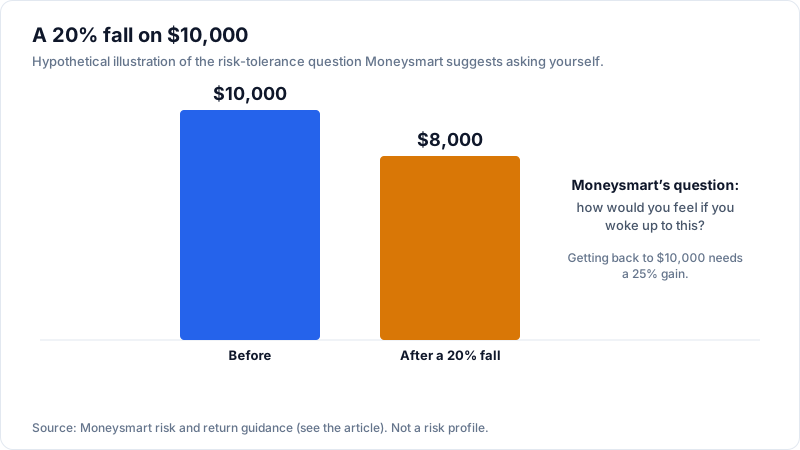
Moneysmart defines risk tolerance as your ability to cope with falls in the value of your investments, and suggests asking how you would feel if you woke up and found your investments had dropped 20% (Moneysmart). Answers tend to lean in one of two directions. These are tendencies, not types.
Leaning Cautious
You prefer certainty and keep a large share of your money in cash. Cash is generally suited to short-term goals, roughly within three years, according to Moneysmart (Moneysmart), so holding it for those goals is sensible. Moneysmart also lists inflation risk, meaning investments not keeping pace with inflation, among the general risks that affect investments. The question is whether the cash you hold matches the time frame of the goal it is for. For goals five or more years away, Moneysmart says shares and property are generally the assets that suit, because long-term investors can ride out short-term falls.
Leaning Bold
You are drawn to fast returns, tips and leverage, perhaps to catch up. Moneysmart's investment scam page lists warning signs including easy money with high returns and low risk, unsolicited contact, pressure to act or to swap your investment, and hype about listed stocks on social media (Moneysmart). Its main message is that "there's always a catch". If an offer is hard to wait on, that is a reason to check it, not to hurry.
Diversifying across investment types reduces reliance on any one, but Moneysmart notes it does not remove the risk of loss.
What Australia's Settings Do and Do Not Do
Two facts are worth separating from personal history:
- Deposit protection. The Financial Claims Scheme protects deposits with Australian-incorporated, APRA-authorised banks, building societies and credit unions up to $250,000 per account holder per institution if the institution fails, and the Government must activate it (APRA). It protects deposits, not investments such as shares or funds.
- Inflation target. The Reserve Bank aims to keep consumer price inflation between 2 and 3 per cent, while allowing the Board to look through short-term deviations (RBA). That is a target, not a guarantee of any particular rate.
A Short Reflection Exercise
- Write down the first money-related memory that comes to mind, good or bad.
- Note what it taught you about money, institutions or risk.
- Ask whether that lesson still matches your situation today, your time frame, and the protections that exist.
- Name any correction before your next money decision that feels similar.
You can repeat this whenever a decision feels more emotional than the numbers justify.
Before You Invest
Moneysmart suggests asking how an investment works, how you could make or lose money, how and when you could withdraw, what the fees are, how much you could lose and whether you could afford it, and reading the Product Disclosure Statement. If you do not understand an investment, wait, ask questions or consider financial advice from a licensed adviser.
Next Steps
Use the short quiz below as a prompt for reflection; it is not a risk profile and does not suggest what to buy. When you are weighing a specific opportunity, read Verify Before You Invest next.
🧠 The Money Mindset Audit
A six-question reflection exercise on how you tend to react to financial risk. It is not a risk profile and does not suggest what to buy.