Beating the "Lazy Tax" on Energy (Electricity & Gas)
By Dr KH Asadul · Last reviewed 23 October 2026 · General information only, not personal advice
What the Default Market Offer is and is not, what changed on 1 July 2026, how to read an energy bill, and where to compare plans.
Beating the "Lazy Tax" on Energy
Many households pay for electricity and gas without ever comparing plans. The "lazy tax" is a label for the extra you might pay by staying on a plan that is no longer competitive. Whether it applies to you depends on your plan, your region and how much energy you use. This article explains what the Default Market Offer (DMO) is, what the 2026–27 determination changed, how to read a bill, and where to compare plans. It is general information as at 23 October 2026, not personal advice.
What the Default Market Offer Is
The Australian Energy Regulator (AER) describes the DMO as the maximum price retailers can charge residential and small business customers on a standing offer, which is the default plan you are on if you never chose a market plan, or have moved into a property and not yet contacted a retailer. It applies only in South Australia, New South Wales and South East Queensland, and its annual price is fixed each 1 July for 12 months (AER).
Two points follow:
- The DMO limits standing offers. It does not set the price of a market offer, which is a competitive plan designed by a retailer. Retailers must show how their market plans compare with the DMO in advertising, so it works as a reference price.
- The AER says the DMO may not be the lowest-priced plan, and that fewer than 10% of households are on the DMO (its 2026–27 information kit gives about 8%). Most readers are therefore on a market offer whose price the DMO did not set.
What Changed From 1 July 2026
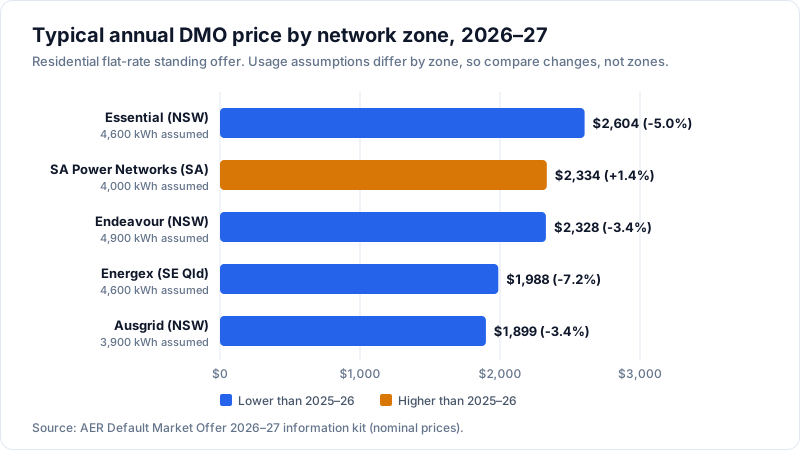
The AER's 2026–27 information kit gives these typical annual prices for residential flat-rate standing offers, based on average usage in each network zone, with changes from 2025–26 (AER information kit):
| Network zone | Assumed usage | 2026–27 annual price | Change |
|---|---|---|---|
| Ausgrid (NSW) | 3,900 kWh | $1,899 | −3.4% |
| Endeavour (NSW) | 4,900 kWh | $2,328 | −3.4% |
| Essential (NSW) | 4,600 kWh | $2,604 | −5.0% |
| Energex (SE Queensland) | 4,600 kWh | $1,988 | −7.2% |
| SA Power Networks (SA) | 4,000 kWh | $2,334 | +1.4% |
These are nominal figures, so the AER notes real reductions are larger after inflation. If you live in Victoria, Tasmania, the ACT, Western Australia or the Northern Territory, these figures do not apply to you; Victoria has its own default offer.
The Solar Sharer Offer
The AER information kit also describes a new opt-in time-of-use plan, the Solar Sharer Offer, which retailers with more than 1,000 residential customers must offer. It provides three hours of free electricity a day (11am to 2pm in NSW and South East Queensland, 12pm to 3pm in South Australia), with free use capped at 24 kWh a day and regulated rates above that. It is designed for smart-meter customers who can move some use, such as laundry or electric vehicle charging, into the free window. Whether it suits you depends on when you use power.
How to Read a Bill
Compare plans on two numbers, which appear on your bill and on every plan's fact sheet:
- Daily supply charge: what you pay each day to be connected, whether or not you use power. It is quoted in cents a day.
- Usage charge: what you pay per kilowatt-hour (kWh) consumed, in cents per kWh. Some plans have time-of-use or tiered rates.
Also check the details that change the real cost: conditional discounts (for example for paying on time), exit fees, how long the contract runs, and what the price becomes when a benefit period ends.
A Hypothetical Example
Suppose a household uses 4,600 kWh a year (the AER's assumed usage for Energex and Essential). The prices below are illustrative, not real offers.
| Daily supply | Usage | Annual cost | |
|---|---|---|---|
| Current plan | 100 c/day | 30 c/kWh | $1,745 |
| Alternative plan | 95 c/day | 27 c/kWh | about $1,589 |
The difference is about $156 a year. That is a modest saving, and the result could reverse if a discount were conditional or the price rose after a benefit period. The point is to compare on your own bill, not to assume a number.
Where to Compare Plans
- Energy Made Easy is the government comparison service, described as free and independent. The page lists New South Wales, Queensland, South Australia, Tasmania and the ACT, and says you can add usage information, including your National Meter Identifier (NMI), to compare against your own use (Energy Made Easy). The AER's own kit recommends it for finding cheaper deals.
- Victorian Energy Compare is the Victorian government's equivalent (Victorian Energy Compare).
- Commercial comparison sites may be useful, but check what they cover. A CHOICE article from July 2022 reported that two sites earned commissions and did not compare all retailers, and that one captured only seven of 40 retailers at the time. The sites said commissions did not influence what they showed, and the article is dated, so check the current position before relying on it (CHOICE).
Checklist
- Find your latest bill and note the supply charge, usage charge, discounts and plan type.
- Check whether you are on a standing offer or a market offer; call your retailer if unsure.
- Compare using your own usage on a government service and read the fact sheets.
- Check exit fees, lock-in periods and what happens when a discount ends.
- If you have a smart meter and can shift use to midday, ask about the Solar Sharer Offer.
Next Steps
Use the calculator below to estimate the annual difference between two plans using your own numbers, then confirm the details on the retailer's fact sheet before switching.
⚡ "Lazy Tax" Energy Calculator
Estimate the annual difference between two plans using the rates on your bill and a plan fact sheet. The starting figures are illustrative, not real offers.
Check your bill for average daily use. The default of 12.6 kWh/day is about 4,600 kWh a year, the AER's assumed usage for some network zones.
Current Plan
Alternative Offer
Estimated Annual Difference
On these inputs the alternative offer would cost about this much less per year than your current plan.
Not modelled: conditional discounts, exit fees, lock-in periods, price changes when a benefit period ends, time-of-use rates, solar feed-in and GST rounding. Check the retailer's fact sheet and compare on Energy Made Easy (or Victorian Energy Compare in Victoria). This is general information, not personal advice.