Introduction to the ASX & CHESS Sponsorship
By Dr KH Asadul · Last reviewed 11 October 2026 · General information only, not personal advice
When you decide to invest in the stock market, you are buying tiny pieces of ownership (shares) in publicly listed companies. In Australia, the primary marketplace where these companies are bought and sold is the Australian Securities Exchange (ASX).
Introduction to the ASX & CHESS Sponsorship
You cannot just walk into the ASX with cash to buy a share. You must use a middleman known as a broker. Decades ago, this was a person you called on the phone. Today, it is usually an app or website.
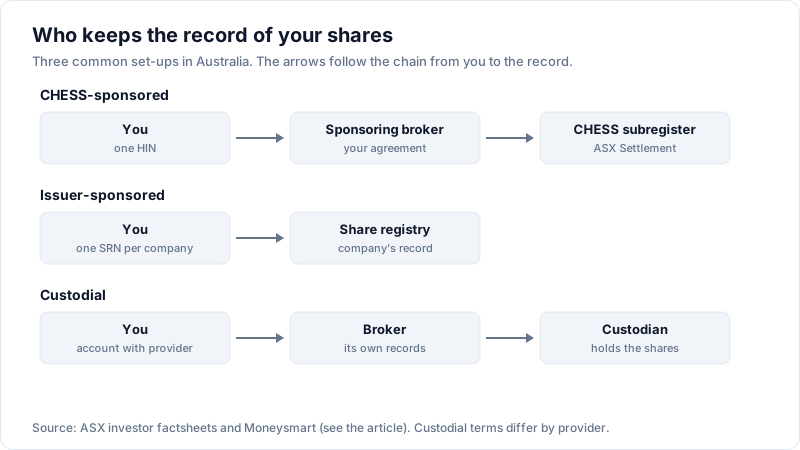
When you use an app to buy shares in a company like BHP or Woolworths, how do you prove you own them? That depends on how your broker registers your ownership. In Australia there are three common set-ups: CHESS-sponsored, issuer-sponsored and custodial.
What CHESS Is
CHESS (Clearing House Electronic Subregister System) is the system ASX uses to settle trades and record who owns shares. ASX's investor FAQ explains that buying or selling shares on the ASX requires a CHESS sponsoring broker, and that your HIN appears on the "Welcome" letter and holding statements you receive (ASX investor FAQ).
CHESS-Sponsored Holdings
If you use a CHESS-sponsoring broker, you are issued a Holder Identification Number (HIN). ASX describes it as similar to an account number. It is issued by your sponsoring broker, and it covers all your CHESS holdings across different companies (ASX factsheet).
- How it works: Your holding is recorded on the CHESS subregister, which ASX Settlement maintains, and linked to your HIN. You need a sponsoring broker and a signed sponsorship agreement.
- The benefit: Your holding is registered in your name on a central record, not only in your broker's own books. You update your name, address or tax file number through your sponsoring broker, and your broker controls transfers in and out only on your instructions and under your agreement.
- Statements: Changes are notified by a holding statement, mailed or made available electronically. CHESS statements are issued by ASX Settlement.
Issuer-Sponsored Holdings
With an issuer-sponsored holding, the company (usually through its share registry) keeps the record instead. No sponsorship agreement is needed, and you receive a Security Holder Reference Number (SRN) for each company, so a portfolio of ten companies means ten SRNs (ASX factsheet).
Two practical differences matter:
- Changing your details: You must tell each company's share registry separately.
- Selling: An issuer-sponsored holding must be converted to CHESS before it can settle, so you need to give your broker your SRN in time. Late conversion may incur a fee that your broker can pass on to you.
The Custodial Model
Many newer apps, and brokers who offer international shares, use a custodial model. You do not get a HIN. The broker or a custodian holds the shares and keeps its own records of what belongs to you. This can make small trades and fractional shares easier to offer, but the arrangements differ between providers.
What happens to your investments if a custodial provider fails depends on its structure and terms, so read the provider's product documents before relying on it. Neither ASX nor Moneysmart sets out a general rule on this.
How the Three Compare
| CHESS-sponsored | Issuer-sponsored | Custodial | |
|---|---|---|---|
| Who keeps the record | CHESS subregister (ASX Settlement) | The company's share registry | Your broker or its custodian |
| Your reference | HIN (one per sponsoring broker) | SRN (one per company) | Account with the provider |
| Updating your details | Through your sponsoring broker | With each company's registry | With the provider |
| Selling | Settles directly | Must convert to CHESS first | Through the provider |
How Buying Works
Moneysmart sets out the process: open an account with a broker, transfer money from your bank, place an order for the company and number of shares, then check the confirmation for price, quantity and fees and keep it for tax (Moneysmart).
- A market order executes at the next available price. A limit order sets your maximum buy or minimum sell price and only executes if the market reaches it.
- Sale proceeds reach your brokerage account two business days after the trade (T+2), according to Moneysmart.
What to Compare When Choosing a Broker
- Brokerage: Moneysmart notes that smaller trades at online brokers often carry a flat fee of about $20 or less, with larger trades usually shifting to a percentage. Some brokers charge one flat fee regardless of size.
- Platform, monthly or inactivity fees.
- Foreign exchange fees if you plan to buy overseas shares.
- Total cost at your typical trade size, not just the headline fee.
- Whether you need advice or just execution: online brokers leave the choice to you, while full-service brokers can advise but charge more.
- Whether the broker is CHESS-sponsoring, and whether you receive a HIN.
Which One Suits You?
There is no single right answer, and it depends on your goals. A custodial app may suit a small, regular amount if you value low fees and simplicity, while a CHESS-sponsored broker may appeal if you want holdings recorded in your own name on a central register. Whichever you choose, read the provider's terms and ask:
- Do I get a HIN, and who is my sponsoring broker?
- If the broker uses a custodian, who is it, and where is it regulated?
- What does it cost in total at my trade size?
- How do I transfer my holdings if I want to move?
A Note on the CHESS Replacement
ASX has been developing a replacement for CHESS for years. According to ASIC, the project was re-scoped in November 2023 into two releases: Release 1 (clearing services) went live on 20 April 2026, and Release 2 (settlement and subregister services) is still to come. ASIC's media release does not give a date for Release 2. In the same release, ASX admitted that a February 2022 statement that the project was "progressing well" was misleading, and ASIC and ASX have asked the Federal Court to impose a $20.5 million penalty. The court reserved its decision on 1 July 2026.
Note: this is correct as at 11 October 2026 and the position can change. Please check ASX's CHESS replacement pages for current information. As an investor you do not need to take any action based on this.
Interactive: Ownership Structure Visualizer
See how the chain of ownership differs between the models, and what each one means for your records.
🔗 Ownership Structure Visualizer
See who actually holds the legal title to your shares.
ℹ️ How it works normally
The broker acts merely as a portal. When you buy a share, the ASX registers it directly to your unique Holder Identification Number (HIN). You are the undisputed, absolute legal owner of the shares.