The 50/30/20 Budgeting Rule
By Dr KH Asadul · Last reviewed 11 October 2026 · General information only, not personal advice
The 50/30/20 rule is a simple, percentage-based framework designed to help you organize your after-tax (net) income into three clear buckets. By categorizing your money, you can prioritize essential expenses, enjoy your life, and build your future wealth simultaneously.
The 50/30/20 Budgeting Rule
Most budgets fail for a simple reason: they ask you to track dozens of categories, and nobody keeps that up for long. The 50/30/20 rule is popular because it does the opposite. It gives you three buckets and one question to ask each payday: is my money going where I want it to go?
The rule was popularised by Elizabeth Warren and her daughter Amelia Warren Tyagi in their book All Your Worth. It is a rule of thumb, not a law of nature, and it was written with a US household in mind. This guide adapts it to Australian conditions and shows you where it works and where it needs adjusting.
The Breakdown
The percentages apply to your after-tax (net) income, meaning the money that actually lands in your account after PAYG withholding and any salary sacrifice has come out. They are not applied to your gross salary.
- 50% for Needs (Essential Expenses) These are the non-negotiables you need to function and live.
- Examples: Rent or mortgage payments, groceries, utilities (electricity, gas, water), internet, transport (rego, fuel, public transport), insurance, and minimum debt repayments.
- 30% for Wants (Discretionary Spending) These are the things that improve your quality of life but aren't strictly necessary for survival.
- Examples: Dining out, takeaway, entertainment subscriptions (Netflix, Spotify), hobbies, holidays, and non-essential shopping.
- 20% for Savings & Financial Goals This is your "future-self" bucket, used to build security and wealth.
- Examples: Building an emergency fund, making extra mortgage/debt repayments (to save on interest), investing in ETFs/shares, or voluntary Superannuation contributions.
A Worked Example
Say you take home $5,200 a month after tax. The rule gives you these targets:
| Bucket | Share | Monthly amount |
|---|---|---|
| Needs | 50% | $2,600 |
| Wants | 30% | $1,560 |
| Savings and goals | 20% | $1,040 |
Now check it against reality. Add up what you actually spent last month on rent or mortgage, groceries, bills, transport, insurance and minimum repayments. If that total is $2,450, you are inside the Needs target and have $150 of room to move into savings. If it is $3,380, your Needs are 65% of your income, and the rule is telling you something useful: housing and fixed costs are crowding out everything else, and that is where any change has to happen.
Needs or Wants? The Grey Areas
Most of the friction in this rule comes from deciding which bucket a cost belongs in. A few common ones:
- Groceries are a Need, takeaway is a Want. If you spend $250 a week on food, some of that is probably the second kind.
- Phone and internet are Needs, but the premium plan is partly a Want. You need a connection, not necessarily the most expensive one.
- Insurance is a Need, but paying more than you must because you never compared policies is a cost you can reduce.
- Minimum debt repayments are Needs. Anything above the minimum belongs in the 20% bucket, because it is you choosing to build your financial position.
- Annual and irregular bills. Car rego, insurance renewals and vet bills are Needs, and they hit as lumps. Divide the yearly total by 12 and treat it as a monthly Need so it does not blow up one month.
The Moneysmart guidance on tracking spending takes a similar approach: sort costs into needs and wants, then look at reducing the wants first.
The Australian Reality Check
While 50/30/20 is the "ideal" model, many Australians find that essential costs (especially housing) consume more than 50% of their income. If your "Needs" are currently closer to 65% or 70%, that is not a budgeting failure—it is a reflection of current economic realities. The rule was never meant to make you feel bad about a rent you cannot negotiate.
If you can't hit 50/30/20 today, try "The Progressive Shift": aim to reduce your "Needs" by 1–2% through small lifestyle tweaks or shopping around for utility deals, and shift that amount directly into your 20% savings bucket.
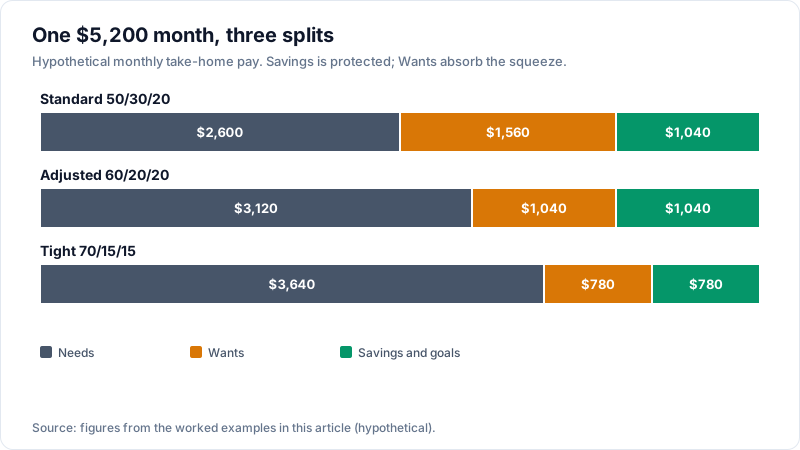
Here is how the numbers move on the same $5,200 take-home if you adjust the split instead of abandoning it:
| Split | Needs | Wants | Savings |
|---|---|---|---|
| Standard 50/30/20 | $2,600 | $1,560 | $1,040 |
| Adjusted 60/20/20 | $3,120 | $1,040 | $1,040 |
| Tight 70/15/15 | $3,640 | $780 | $780 |
Notice that in the adjusted versions the savings bucket is protected and the Wants bucket absorbs the squeeze. That is deliberate: a small, steady savings habit matters more than the exact percentage, and Wants are the easiest place to flex.
Where the Rule Falls Short
Be honest about the limits, because they decide whether this method suits you:
- Irregular income. If you are a contractor, casual worker or run a business, no two months look alike. Moneysmart's budgeting steps suggest averaging your income over several months rather than basing the budget on your best one.
- High debt. If you carry credit card debt, 20% may need to go almost entirely to clearing it, with nothing left for investing until it is gone. Our guides on the debt avalanche and snowball methods cover how to order those repayments.
- Very low incomes. When essentials alone take 80% or more, percentages stop being helpful. A line-by-line budget and checking you are receiving every payment you are entitled to will do more good.
- Very high incomes. A high earner may find 50% on Needs far too generous. The rule describes a minimum for savings, not a ceiling.
How to Start This Week
- Pull your last three months of statements. Look at actual spending, not what you remember spending.
- Sort each line into Needs, Wants or Savings. Don't agonise over the grey areas; pick a bucket and stay consistent.
- Calculate your real percentages. Use the splitter below to compare them with the targets.
- Automate the 20%. Set up a transfer to a separate savings account on payday, so saving happens before spending does.
- Review monthly. Adjust the split when your income, rent or goals change.
A Note on the Numbers
Percentages and examples on this page are illustrations based on a hypothetical take-home pay and are not a recommendation for any particular person. The sources listed at the bottom of this page are from Moneysmart, ASIC's free consumer money site, for budget tools and step-by-step guidance.
Interactive: Budget Splitter
Use the calculator below to see how your monthly net income translates into these three buckets.
📊 The 50/30/20 Budget Splitter
Calculate your ideal budget breakdown based on your after-tax income.
Rent, groceries, utilities, minimum debt payments.
Dining out, entertainment, hobbies, subscriptions.
Emergency fund, investments, extra debt payoff.