How Super Works (The Super Guarantee Rate)
By Dr KH Asadul · Last reviewed 11 October 2026 · General information only, not personal advice
Who gets super, what the Super Guarantee rate is, how Payday Super changed when you are paid from 1 July 2026, and when you can access your money.
How Super Works (The Super Guarantee Rate)
Superannuation, or super, is the retirement savings system built into Australian employment. Most employers must pay a percentage of your earnings into a super fund for you, and the money is generally locked away until you meet a condition of release. This article covers who gets super, what rate applies, how the Payday Super rules that started on 1 July 2026 change when you are paid, and when you can access the money. It is general information as at 11 October 2026.
Who Gets Super
The ATO says employers generally must pay super for all employees, whether full time, part time or casual. Independent contractors paid mainly for their labour are treated as employees for super, and temporary residents are generally covered with some exceptions. Earnings don't affect eligibility, since "you're eligible for super guarantee regardless of how much you earn". Age matters only for workers under 18 and for private or domestic workers, who are eligible only if they work more than 30 hours in a week (ATO).
Most employees can choose the fund their contributions are paid into. If you change jobs, ask your new employer whether you have a stapled fund, which is your existing fund that follows you unless you choose another.
The Super Guarantee Rate
The minimum employer contribution is called the Super Guarantee (SG). The rate is 12% from 1 July 2025, and the ATO lists the rate as 12% for 2026–27 and later years (ATO). Rates are set by law, so check the ATO for the current figure.
From 1 July 2026 the minimum is calculated on your qualifying earnings, which combine ordinary time earnings with other payments such as all commissions and salary sacrifice contributions. Employers don't have to pay SG on earnings above the maximum contribution base, which is $270,830 a year for 2026–27 (ATO).
As a hypothetical example, if your qualifying earnings are $100,000 a year, your employer must pay at least $12,000 into your super fund on top of your pay.
"Plus Super" vs "Inclusive of Super"
When you negotiate a job offer, check how the salary is worded:
| Offer | Salary you receive | Paid to super | Total cost to employer |
|---|---|---|---|
| $100,000 plus super | $100,000 | $12,000 | $112,000 |
| $100,000 inclusive of super | about $89,286 | about $10,714 | $100,000 |
The second row divides $100,000 by 1.12. On an inclusive offer, the same total cost to the employer gives you a lower salary. Ask for the salary and the super to be stated separately.
Payday Super
From 1 July 2026, Payday Super changed when super must be paid. Contributions must now reach the employee's fund no more than 7 business days after payday, where before employers had until 28 days after each quarter ended. The ATO's example is a payday of 10 July 2026, which gives a deadline of 21 July 2026. The clock stops when the fund receives the contribution, not when the employer sends it. The ATO says there are situations with a longer period, such as when a new employee starts (ATO).
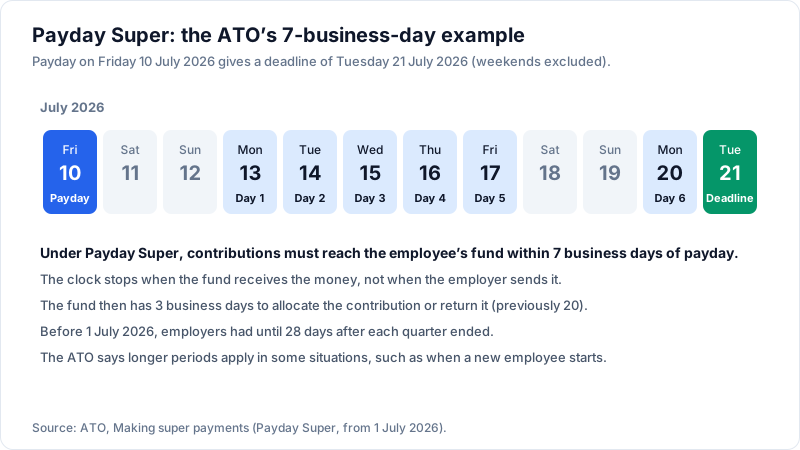
Other changes the ATO lists (ATO):
- Funds have 3 business days to allocate or return contributions, down from 20.
- The ATO now assesses the super guarantee charge for late or unpaid super. The charge is based on qualifying earnings and interest compounds daily. Penalties are 25% or 50% of the unpaid charge, depending on prior penalties.
For you, this means contributions should reach your fund sooner and more often. That can add a little growth over time. The calculator below shows an illustration, but it depends on how often your employer paid before. If your super is not paid, the employer is liable for the super guarantee charge, and you can call the ATO on 13 28 65.
When You Can Access Your Super
Super is preserved, which means you can't withdraw it freely. The ATO says you can access it when:
- you turn 65, even if you are still working;
- you reach your preservation age and retire;
- you reach your preservation age, keep working, and start a transition to retirement income stream; or
- you meet a condition that allows early access.
Preservation age is 60 for anyone born from 1 July 1964. Retirement means you have stopped paid work and your fund is satisfied you have no intention of being employed again (ATO).
Early access is allowed in very limited circumstances, including severe financial hardship, compassionate grounds, incapacity, terminal medical conditions, voluntary contributions released under the First Home Super Saver scheme, and some cases for temporary residents leaving Australia. Moneysmart explains, for example, that under 60 you may withdraw up to $10,000 on hardship grounds if you've received eligible income support for at least 26 weeks and have no other way to pay living costs, once every 12 months (Moneysmart).
A Short Checklist
- Check your payslip shows super, and that it appears in your fund soon after payday.
- Confirm which fund you are in, and whether you have more than one.
- Find out how your employer words salary offers: plus super, or inclusive.
- If super is missing, ask your employer first, then contact the ATO.
Next Steps
Moneysmart's overview of how super works links to pages on choosing a fund, fees, tax and insurance (Moneysmart). Our articles on the First Home Super Saver scheme and on choosing a fund cover two decisions to make next. Use the calculator below to see how payment frequency affects a balance under assumptions you can change.
This is general information as at 11 October 2026, not financial advice. Rates, thresholds and rules change, so check the linked ATO pages before you act.
🚀 The Payday Super Compounding Bonus
See how getting your Super paid more frequently adds thousands to your retirement.
The Math Assumptions:
- Super Guarantee Rate: 12%
- Expected Market Return: 7% p.a.
- Holding period: 35 Years (to age 60, an assumed retirement age)
Assumes contributions arrive 4 times a year. Many employers paid more often than the old quarterly deadline required.
Your employer must now pay super within 7 business days of payday; this assumes it arrives each pay cycle (Fortnightly), so it is invested sooner.
Because your money hits your investment account fortnightly instead of every three months, it spends more time invested. This is an illustration only: it ignores contributions tax, fees, wage growth and the 28-day delay after each quarter under the old rules, and it assumes a fixed return that is not guaranteed.