Life, TPD & Income Protection Insurance
By Dr KH Asadul · Last reviewed 11 October 2026 · General information only, not personal advice
Explaining Life, TPD, and Income Protection Insurance and whether to hold them inside or outside Super.
Life, TPD & Income Protection Insurance
You have insured your car and your house. But what happens if you get sick or injured and your ability to earn an income disappears? This guide explains the main types of personal insurance in Australia, how cover through super works, and what to check before you buy or cancel anything. It is general information and not personal advice, and insurance is complex, so consider speaking to a licensed financial adviser before you cancel, change or apply for any policy.
The Main Types of Cover
Moneysmart describes four main types (Moneysmart):
- Life cover: pays a lump sum when you die.
- Total and permanent disability (TPD) insurance: pays a lump sum to help with rehabilitation and living costs.
- Trauma insurance: pays if you are diagnosed with a major illness.
- Income protection: pays part of your income if illness or injury stops you working.
Income Protection in More Detail
Income protection is different from the lump-sum covers because it pays a regular benefit while you cannot work. Moneysmart explains that it usually replaces a percentage of your pre-tax income, for example 75% or 90%, based on your earnings in the 12 months before the illness or injury (Moneysmart). Policies vary, so check the details of each.
- Waiting period: from 14 days to two years. You must still be unable to work at the end of the waiting period to receive payments. Check how you would cover your living costs during the waiting period.
- Benefit period: payments continue while you remain unable to work. Common options are two or five years, or up to a set age such as 65.
- Exclusions: policies may exclude self-inflicted injury, illegal acts and active military service. Pre-existing conditions and risky activities may be limited or excluded.
- Tax: outside super, premiums are generally a tax deduction, and any benefit you receive must be included in your tax return.
Insurance Inside Your Super
Many people already have some cover through super. Moneysmart says most funds (not SMSFs) give members life and TPD cover automatically from age 25, and some also give income protection. Default cover is for a set amount and usually needs no medical checks (Moneysmart). The rules to know:
- Inactive accounts: by law, super funds cancel insurance on accounts with no contributions for at least 16 months. Some funds also cancel cover if your balance is too low, under their own rules. Your fund should contact you before cover ends. To keep it, tell the fund or add money to the account.
- Under 25 or balance under $6,000: new members in this group don't get automatic cover unless they ask for it. If an existing member's balance drops below $6,000, they usually keep their cover.
- When cover ends: TPD in super usually ends at 65 and life cover at 70.
- Cost: premiums are deducted from your super balance, which reduces your retirement savings. Higher-risk people may pay a loading.
- Multiple accounts: several super accounts can mean several premiums, and you may not be able to claim the full benefit from more than one policy.
To check what you have, call your fund, log in online, or read your annual statement and product disclosure statement (PDS). Confirm the cover type, amount, premiums, and when cover ends or can be cancelled. Check your cover before you switch funds or close an account. Our guide to lost super covers consolidating accounts.
What Insurance in Super Can Cost You
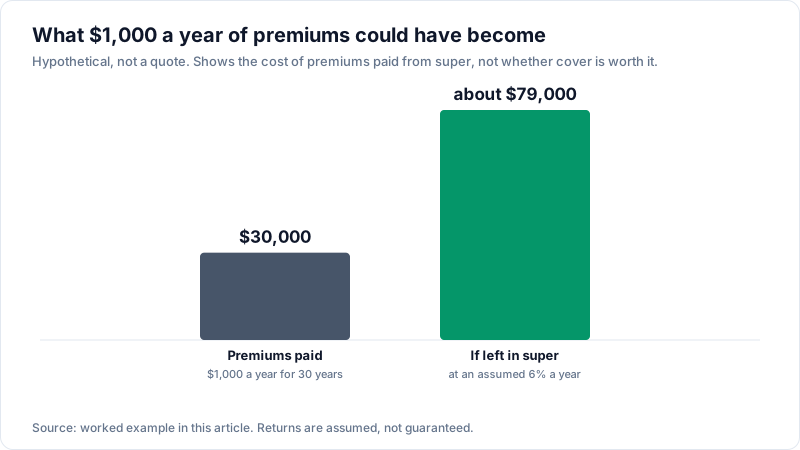
Every dollar spent on a premium inside super is a dollar that is not growing for your retirement. As a hypothetical example, not a quote: if premiums of $1,000 a year had instead stayed in your super and earned an assumed 6% a year for 30 years, they would have grown to about $79,000. The real figure depends on your premiums and returns, and the cover itself has value, so this is a cost to weigh and not a reason to cancel.
Cover Inside Versus Outside Super
You can hold cover through your super fund or buy it directly from an insurer. There are trade-offs on both sides, and what suits you depends on your circumstances:
- Inside super: premiums come out of your super balance and not your bank account, which helps day-to-day cash flow, but they reduce your retirement savings.
- Outside super: premiums come from your after-tax income, and for income protection are generally tax deductible. Moneysmart notes that if you are over 60 or have a pre-existing condition, you may not be able to get the cover you want elsewhere, so be careful before you cancel existing cover.
How Much Cover Might You Need?
Moneysmart's life insurance calculator estimates whether you need life cover and how much, based on funeral costs, mortgage and other debts, children's education costs, up to 10 years of family living costs, and your assets (Moneysmart). Moneysmart also advises checking whether you already have insurance through super so you don't pay for it twice.
What to Check in a Policy
Insurers must give you a PDS before you buy. Moneysmart says to check what is covered and excluded, what information you need to give the insurer, premiums and how they change over time, waiting periods, how to make a claim, and how to complain about claims. Moneysmart's claims comparison tool compares life insurers on the share of claims they accept, how long they take to decide, and disputes per 100,000 lives insured (Moneysmart).
If you need to claim, contact the insurer, broker, adviser, super fund or employer that arranged your policy, with your policy number and your medical, work and income records. If a claim is declined, raise a complaint with the insurer or fund first, and if that fails you can approach the Australian Financial Complaints Authority (AFCA) for free, independent dispute resolution (Moneysmart).
Note: the rules in this article are as at 11 October 2026 and can change. Check Moneysmart and your fund for current details.
Interactive: Inside vs. Outside Super Visualizer
Is it better to pay your insurance premiums out of your super, or out of your own pocket? Use this tool to see the long-term cost of premiums paid from your retirement savings, alongside the value of the cover.
⚖️ Inside vs Outside Super Visualizer
See the true long-term cost of paying insurance premiums out of your retirement balance.
Total Premiums Paid
Lost Retirement Wealth
Because every dollar spent on insurance inside super is a dollar that isn't compounding for your retirement.