The Emergency Fund (Your Ultimate Self-Insurance)
By Dr KH Asadul · Last reviewed 11 October 2026 · General information only, not personal advice
Why the best insurance policy is cash in the bank and how much you need.
The Emergency Fund (Your Ultimate Self-Insurance)
Other guides on this site cover insurance, super and everyday bills. Those are products you buy or settle into. An emergency fund is different: it is your own cash, set aside so that a bad month does not turn into a debt problem.
An emergency fund is money kept in an easy-to-reach account for costs you need to pay quickly when other money is not available, such as a sudden loss of income, an urgent medical bill or an essential car repair. It is not a general savings goal, and it is not an investment.
What an Emergency Fund Is For
Moneysmart, the government's consumer finance site, says to use an emergency fund only for expenses you need to pay quickly when other money isn't available. If a cost can wait, it suggests saving for a few weeks and paying from savings instead of dipping into the fund (Moneysmart).
The fund also covers the gaps that insurance leaves. Income protection policies have a waiting period before payments start, and Moneysmart says most policies offer a period between 14 days and two years. You must still be unable to work at the end of that period to be paid (Moneysmart). Car and home policies usually have an excess you pay before a claim is paid. Cash in the bank covers those gaps without a credit card.
How Much Is Enough?
Moneysmart says "a good target" is enough to cover three months of expenses, and that you can work out a longer buffer by multiplying your monthly expenses by the number of months you want to cover. Beyond that, the right number depends on your situation. A single-income household, a contractor or a family with dependants may want a longer buffer than a dual-income couple with secure jobs. That is a judgement for you to make, not a rule.
Start with your baseline monthly costs, meaning the bills you would still need to pay if your income stopped:
- Rent or mortgage repayments
- Basic groceries
- Utilities (power, water, internet and phone)
- Essential transport
- Minimum debt repayments and insurance premiums
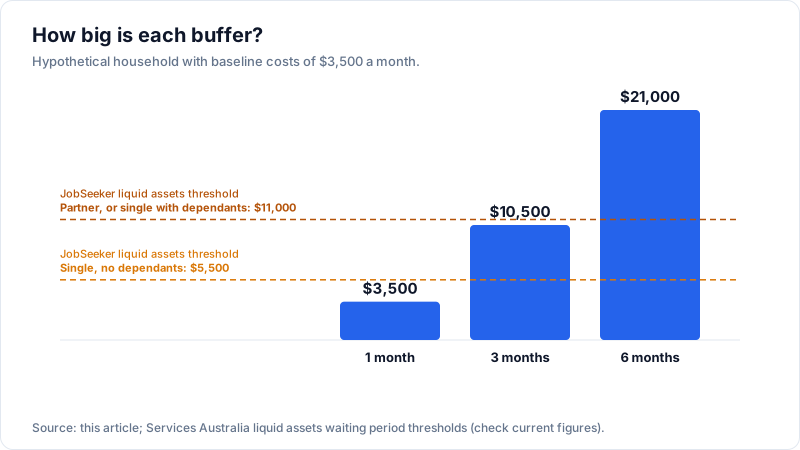
Here is a hypothetical household whose baseline costs are $3,500 a month:
| Buffer | Calculation | Target |
|---|---|---|
| 1 month | $3,500 x 1 | $3,500 |
| 3 months | $3,500 x 3 | $10,500 |
| 6 months | $3,500 x 6 | $21,000 |
If that household saved $200 a week and earned no interest at all, it would reach the 3-month target in about 53 weeks. Interest would shorten that a little. Moneysmart's own example is smaller: $20 a week into a savings account gets you over $1,000 in a year.
Where to Keep It
Moneysmart names two places for an emergency fund. One is a separate high-interest savings account, which makes the money harder to spend on everyday costs. The other, if you have a home loan, is an offset account, which can lower your interest payments and still give quick access to the money.
Some things to weigh up:
- Access: the money should be available within a day or two. That usually rules out shares and term deposits, because prices can fall and early withdrawal can cost you.
- Keeping it separate: many people find it easier not to touch the fund if it sits in a different account from their everyday spending.
- Conditions on savings rates: the headline rate on many savings accounts depends on conditions such as monthly deposits or no withdrawals. Read the article on high-interest savings accounts in this site before you pick one.
- Tax on interest: interest on a bank account is income you declare in your tax return (ATO). An offset account works differently, because it reduces the interest charged on your loan and does not pay you interest. Whether and how that is treated for tax depends on your circumstances, so confirm it with a registered tax agent.
- Deposit protection: the Financial Claims Scheme covers deposits with an authorised deposit-taking institution up to $250,000 per account holder, per institution (APRA).
Something to Know: Your Savings Can Affect Government Support
If you ever need JobSeeker Payment, the liquid assets waiting period may apply. Services Australia counts funds you or your partner can readily access, and the waiting period applies if they are at or above:
- $5,500 if you are single with no dependants
- $11,000 if you have a partner, or you are single with dependants
The wait ranges from 1 to 13 weeks, depending on how far above the threshold your liquid assets are. For a single person with no dependants, $5,500 to $5,999 means a 1-week wait, and $11,500 or more means the maximum 13 weeks. For a partnered person or a single person with dependants, the figures are $11,000 to $11,999 for 1 week and $23,000 or more for 13 weeks (Services Australia).
That does not mean holding less cash is the better choice. A fund that lasts you through that waiting period is still cash you control. It is a reason to know the rule before you need it. Thresholds can change, so check the current figures and whether you would be eligible at all.
Building the Fund
Moneysmart's suggestions are practical: set up an automatic transfer from your wage account, ask your employer to pay part of your wage straight into the fund, and add extra money when you can, such as a tax refund.
The order of priorities is personal. If you carry debt at a high interest rate, such as a credit card, the interest you pay on the debt may be higher than the interest you earn on savings. Many people build a small buffer first so that one surprise doesn't add to the debt, then work on the debt, then grow the fund. Our article on high-interest debt looks at how to compare the options.
Next Steps
Work out your baseline monthly cost with the calculator below. Decide on a first target, such as one month, and set up an automatic transfer to a separate account. Once you have a buffer in place, you can look at the investing articles with more confidence, because a market fall or a lost job will no longer force you to sell.
Figures and thresholds in this article are as at 11 October 2026. JobSeeker thresholds, savings rates and tax rules change, so check the linked sources before you act.
Use the calculator to work out how much cash you need and how long it will take you to build it.
🛡️ Emergency Fund Calculator
Calculate exactly how much cash you need to survive a sudden loss of income, and see how long it will take you to build that safety net.
1. Baseline Monthly Survival Costs
2. Safety Target & Funding
Target Emergency Fund
Park this in a Mortgage Offset account or High Yield Savings Account (HYSA).