Car & Home Insurance (The Loyalty Penalty)
By Dr KH Asadul · Last reviewed 11 October 2026 · General information only, not personal advice
Exposing the algorithms insurers use to slowly increase premiums on customers who auto-renew.
Car & Home Insurance (The Loyalty Penalty)
Have you ever opened your car or home insurance renewal notice and found the premium has jumped, even though you haven't made a claim, haven't moved, and your car is a year older and worth less? You are not imagining things, and you are not the only one who has noticed. This guide explains what regulators have found about renewal pricing, and gives you a routine for checking your policy each year. It is general information and not personal advice.
What the Regulators Have Found
General insurers (car, home and contents) set their own premiums, and ASIC regulates how they treat customers. ASIC's Report 765, When the price is not right (June 2023), looked at eleven insurers covering about 68% of the market. The insurers estimated more than $815 million in remediation for over 5.6 million consumers, because discounts and loyalty rewards they had promised were not delivered in full (ASIC).
The report also discusses what it calls "loyalty taxes", where customers who renew and are less likely to shop around pay more than comparable new customers. It cites ACCC data showing that in 2018 renewing home and contents customers in Northern Australia paid 7% to 24% more than new customers. That figure is old and regional, so treat it as an illustration and not today's national average. ASIC also says insurers must not describe customers as rewarded for loyalty unless that is objectively true.
In September 2025, ASIC started Federal Court action against RACQ Insurance, alleging that its renewal certificates and reminders showed a "last period premium" that was the original premium offer and left out later changes, so it was not the current price. ASIC alleges this gave customers a misleading basis for comparing their policy with the market. These are ASIC's allegations and not findings by the court (ASIC).
Note: these matters are as at 11 October 2026 and may develop, so check ASIC's website for the latest.
A Four-Step Renewal Routine
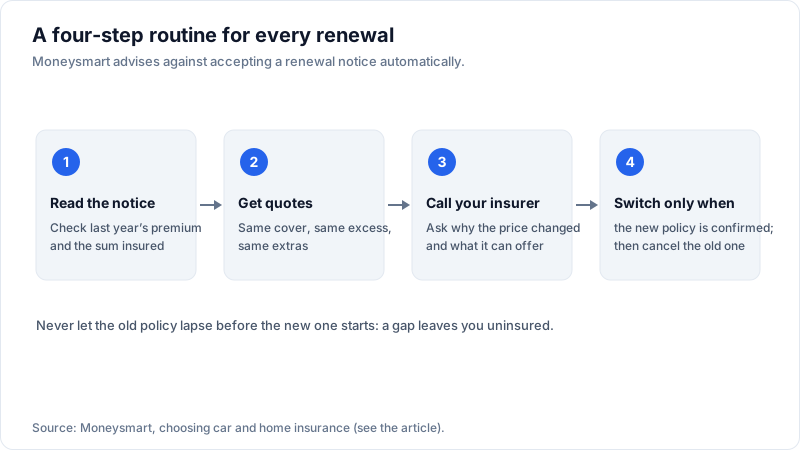
Moneysmart advises you not to accept a renewal notice automatically. Read it, ask why the premium has changed, then decide whether to stay, switch or negotiate (Moneysmart).
- Read the notice and check last year's premium against your own records. Compare the sum insured or agreed value as well as the price.
- Get quotes for identical cover. Compare the same level of cover, the same excess and the same extras, such as hire car cover. Moneysmart says to use the Insurance Council's "find an insurer" service to build a shortlist, and notes that comparison websites may not show all your options and can earn money from promoted links.
- Call your insurer. Ask why the price changed and whether it can offer a better price for the same cover. Savings vary, and an insurer may or may not move. Ask about no-claim bonuses, multi-policy discounts and any other discounts you might qualify for.
- Switch only when the new policy is confirmed. Do not cancel the old policy until the new one is in place.
Be Careful With "Turn Off Auto-Renew"
Some people turn off auto-renewal so they have to look at the price each year. That can work, but a lapsed policy leaves you uninsured. If you turn it off, put the renewal date in your calendar and line up your replacement cover before the old policy ends. Compulsory Third Party (CTP) insurance is required to register a car, and in some states it is included in registration (Moneysmart).
If You Call: A Sample Script
Be polite and factual. Only use this if you actually hold a competing quote for the same cover:
"Hi, I'm calling about my upcoming renewal. I've been with you for [X] years and I'd like to stay, but I've received a quote from [insurer] for the same level of cover for [amount] less. Is there anything you can do on the price?"
This works best because you are specific, honest and asking a clear question. If the insurer cannot help, you have lost nothing and can decide whether to switch.
Compare More Than Price
Moneysmart warns against choosing on price alone, because the cheapest policy may not give you the cover you need.
Car insurance (Moneysmart):
- Type of cover: third party property damage, third party fire and theft, or comprehensive.
- Agreed or market value: agreed value is set by you and the insurer, and may be reduced each year as the car ages, so check it at every renewal. Market value is set by the insurer at the time of the claim.
- Excess: check whether it applies even when the accident isn't your fault. A higher excess can lower the premium.
- Exclusions and extras: for example wear and tear, rust, storm damage, roadside assistance and hire car cover.
Home insurance (Moneysmart):
- Sum insured: it should cover the full cost of rebuilding, including extras like landscaping, rubbish removal and solar panels.
- Excess, exclusions and limits: including per-item limits.
- Key Fact Sheet and PDS: insurers must provide a Key Fact Sheet for comparison, and the Product Disclosure Statement (PDS) has the full detail.
The Hidden Risk: Underinsurance
If you haven't reviewed your home policy in 12 months or more, you could easily be underinsured, which means a claim may not pay enough to rebuild after a total loss. Check your cover against current rebuilding costs and not your home's market value, and include extras such as demolition and temporary accommodation (Moneysmart). For contents, "replacement value" cover pays the full cost of buying new items, costs more than value-based policies, and still has per-item limits (Moneysmart).
Ways to Lower Your Premium
- Raise your excess, if you can afford to pay it when you claim.
- Compare policies for the same level of cover, and review your cover at every renewal.
- Add only the optional extras you need.
- Consider paying annually if you can.
Interactive: Household "Lazy Tax" Audit Tool
Use the tool below to compare your current premiums with quotes for the same cover, including the excess.
Next Steps: Now that you have a routine for insurance, the same habit applies to your phone plan. The Telco Trap looks at whether you are overpaying for a big-brand mobile plan.
🛡️ Household Insurance Premium Comparison
Compare your current premiums with quotes for the same level of cover. The starting figures are illustrative. Enter the excess too, because a lower premium with a higher excess is not a like-for-like saving.
Estimated Annual Premium Difference
On these inputs the quotes cost about this much less per year than your current premiums.
This compares premiums only. Check the sum insured, exclusions, waiting periods (health) and the Key Fact Sheet before switching. Paying monthly can cost more than paying annually, per Moneysmart. For health cover, keep approved hospital cover and the excess limits in mind if you want to avoid the Medicare Levy Surcharge. General information, not personal advice.