The Tax Illusion (Why Your Refund Isn't a Bonus)
By Dr KH Asadul · Last reviewed 23 October 2026 · General information only, not personal advice
What a tax refund actually is, how 2026–27 marginal rates, offsets and the Medicare levy work, the Medicare Levy Surcharge thresholds, and how the ATO treats requests to vary PAYG withholding.
The Tax Illusion (Why Your Refund Isn't a Bonus)
A large tax refund feels like a windfall, but the size of a refund does not tell you whether you did well. It reflects how much tax was withheld from your pay during the year compared with the tax you ended up owing after deductions and offsets. This article explains what a refund is, how marginal rates work, how offsets and the Medicare Levy Surcharge (MLS) change your result, and what the ATO says about asking for less tax to be withheld. It is general information as at 23 October 2026, not personal advice.
What a Refund Is
When you lodge a return, the ATO compares the tax withheld from your pay with your tax liability for the year. If more was withheld than you owe, you receive the difference. That difference can come from three sources:
- Over-withholding. Your employer withheld more than your final tax came to, so you were out of pocket during the year.
- Deductions. Work-related or other deductible expenses reduce your taxable income after the tax has already been withheld.
- Offsets. An offset such as the low income tax offset reduces your tax when you lodge.
A refund that comes mainly from deductions or offsets is not a loan to the government. A refund that comes mainly from over-withholding means you could have had the money earlier. Look at your notice of assessment to see which applies.
How Marginal Tax Rates Work
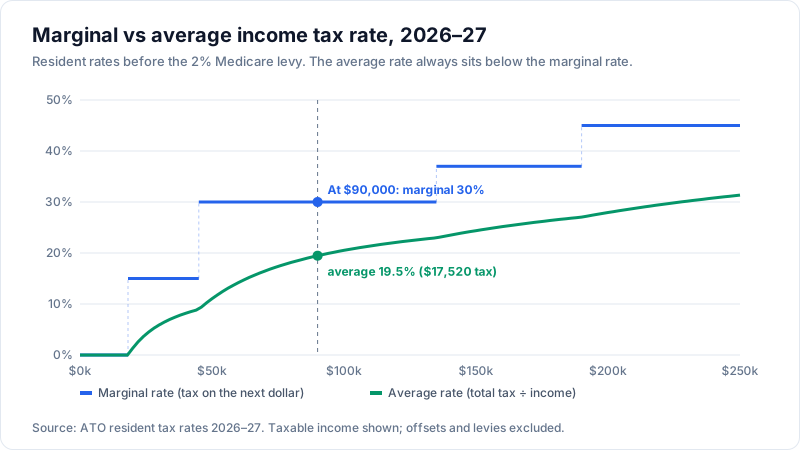
Only the part of your income inside each bracket is taxed at that bracket's rate. A pay rise never reduces your take-home pay because it moves part of your income into a higher bracket. For 2026–27, the ATO's resident rates, which exclude the 2% Medicare levy, are (ATO):
| Taxable income | Tax on this income |
|---|---|
| $0 – $18,200 | Nil |
| $18,201 – $45,000 | 15c for each $1 over $18,200 |
| $45,001 – $135,000 | $4,020 plus 30c for each $1 over $45,000 |
| $135,001 – $190,000 | $31,020 plus 37c for each $1 over $135,000 |
| $190,001 and over | $51,370 plus 45c for each $1 over $190,000 |
The rate on the $18,201 – $45,000 bracket fell from 16% to 15% on 1 July 2026, and the ATO says a further cut to 14% from 1 July 2027 is now law (ATO).
Two Hypothetical Examples
- Average vs marginal rate. On a taxable income of $90,000, tax is $4,020 + 30% × $45,000 = $17,520. Adding the 2% Medicare levy ($1,800) gives $19,320, an average rate of about 21.5%. The marginal rate on the next dollar is 30% plus 2% Medicare, or 32%.
- A pay rise across a threshold. A $2,000 rise from $134,000 to $136,000 puts $1,000 in the 30% bracket and $1,000 in the 37% bracket, so tax is $300 + $370 = $670, plus $40 Medicare levy. You keep about $1,290 of the $2,000.
Offsets and the Medicare Levy
The ATO says the low income tax offset (LITO) is $700 for taxable income of $37,500 or less, falls by 5 cents for each dollar from $37,501 to $45,000, and from there is $325 reduced by 1.5 cents for each dollar above $45,000. You do not claim it separately: the ATO calculates it when you lodge (ATO).
The Medicare levy is 2% of taxable income, but a reduction applies at low incomes. For 2025–26 the ATO's single-person thresholds are $28,011 (lower) and $35,013 (upper) (ATO). The ATO page does not show 2026–27 thresholds, so check the current figures.
The Medicare Levy Surcharge
The MLS is an extra charge if you earn above a threshold and do not hold appropriate private hospital cover. The 2026–27 thresholds and rates are (ATO):
| Status | Income for MLS purposes | Rate |
|---|---|---|
| Single | Up to $105,000 | 0% |
| Single | $105,001 – $123,000 | 1.0% |
| Single | $123,001 – $164,000 | 1.25% |
| Single | $164,001 or more | 1.5% |
| Family | Up to $210,000 | 0% |
| Family | $210,001 – $246,000 | 1.0% |
| Family | $246,001 – $328,000 | 1.25% |
| Family | $328,001 or more | 1.5% |
The family threshold rises by $1,500 for each dependent child after the first. Income for MLS purposes is broader than taxable income: it includes reportable fringe benefits, net investment losses and reportable super contributions, and a spouse's amounts if you have one.
As a hypothetical, a single person with MLS income of $120,000 and no hospital cover would pay 1% of that income, or $1,200. Compare that with the premium for a policy that meets the requirements, and read the health insurance article for the excess limits and what counts as cover.
Asking for Less Tax to Be Withheld
If you often receive large refunds because of over-withholding, you can apply to vary your PAYG withholding. The ATO says a downward variation must be approved by the Commissioner and usually applies when your deductible expenses are higher than normal, such as a vehicle allowance close to your expected car expenses, or rental property losses. Before lodging, you need a valid tax file number, to have lodged all required returns, and to have no outstanding tax debts. The ATO aims to process online applications in 28 days and paper applications in 56 days. The varied rate starts from your next payday after your payer receives the ATO's notice, and if you want it to continue you lodge a new application at least six weeks before it ends (ATO).
Approval does not mean the ATO accepts your tax treatment, because your liability is assessed when you lodge. If you vary too far, you may owe tax at year end.
Checklist
- Read your notice of assessment to see whether your refund came from over-withholding, deductions or offsets.
- Compare your marginal rate with your average rate before reacting to a pay rise.
- If you are near an MLS threshold, work out MLS income and compare the surcharge with a qualifying policy.
- If you consider varying withholding, check the ATO's eligibility conditions first.
- Keep records of deductions for at least five years.
Next Steps
Use the calculator below to see how your taxable income is split across the 2026–27 brackets, with the Medicare levy, the low income tax offset and an optional MLS estimate. It does not include HELP repayments or super, so read Beating HECS/HELP Indexation for those.
💵 Take-Home Pay & Bracket Visualiser
An estimate for a full-year Australian resident using the 2026–27 rates. It does not include HELP repayments or super.
| Bracket | Rate | Income in bracket | Tax |
|---|---|---|---|
| $0 to $18,200 | 0% | $18,200 | $0 |
| $18,201 to $45,000 | 15% | $26,800 | $4,020 |
| $45,001 to $135,000 | 30% | $45,000 | $13,500 |
| $135,001 to $190,000 | 37% | $0 | $0 |
| $190,001 and over | 45% | $0 | $0 |
Marginal vs average rate
Your marginal income tax rate (on the next dollar) is 30%, plus the Medicare levy where it applies. Your average rate across all of your income, including the Medicare levy and any surcharge, is 21.5%.
Assumptions and limits: the Medicare levy phase-in uses the ATO's 2025–26 single thresholds ($28,011 and $35,013) and an assumed 10c-per-dollar phase-in rate; the MLS estimate uses the entered income as MLS income (the ATO's definition is broader) and singles thresholds. HELP repayments, super, other offsets, deductions, family status and part-year residency are not included. General information, not tax advice.