Beating HECS/HELP Indexation
By Dr KH Asadul · Last reviewed 11 October 2026 · General information only, not personal advice
If you have a student loan in Australia, you know that while it doesn't charge traditional interest, it isn't exactly "free money." Each year on June 1, the Australian Taxation Office (ATO) applies indexation to your debt to ensure it keeps pace with the cost of living.
Beating HECS/HELP Indexation
A HELP (HECS) debt does not charge interest, but it does grow every year through indexation, and the compulsory repayment rules have changed recently. This article explains how indexation and repayments work as at 11 October 2026, then looks at the decision many people face: use spare cash to repay the debt early, or invest it. There is no single right answer, and the numbers below are examples to help you test your own.
How Indexation Works
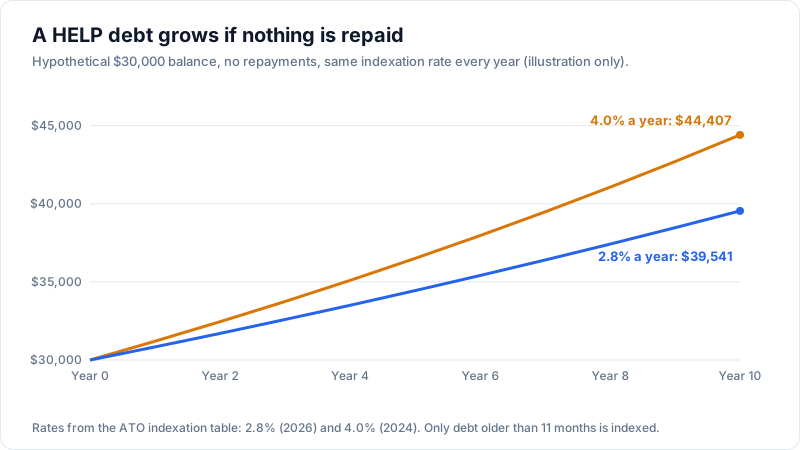
The ATO applies indexation to study and training loans on 1 June each year. Only the part of the loan that has been unpaid for more than 11 months is indexed, so a debt you took on recently is not indexed straight away. Indexation is calculated using the Consumer Price Index (CPI) or the Wage Price Index (WPI), whichever is lower. Legislation passed in November 2024 introduced that cap and backdated it to 1 June 2023 (Study Assist).
The ATO lists these recent rates (ATO):
| Year | Indexation rate |
|---|---|
| 2026 | 2.8% |
| 2025 | 3.2% |
| 2024 | 4.0% (previously 4.7%) |
| 2023 | 3.2% (previously 7.1%) |
From 2025 the rate is worked out each year after the December CPI and WPI figures are released. Your loan grows over time if you make no compulsory or voluntary repayments.
What Has Changed Recently
A 20% reduction. The ATO says it has finished processing the 20% reduction for study and training support debts that existed on 1 June 2025. Where an account ended up in credit, a refund was issued if there were no outstanding tax or other Commonwealth debts (ATO).
Repayments only on income above the threshold. From 1 July 2025, compulsory repayments are calculated only on repayment income above the minimum threshold. For 2026–27 the ATO shows:
| Repayment income | Compulsory repayment |
|---|---|
| $0 to $69,528 | Nil |
| $69,529 to $129,717 | 15c for each $1 over $69,528 |
| $129,718 to $186,050 | $9,028 plus 17c for each $1 over $129,717 |
| $186,051 and over | 10% of your total repayment income |
Repayment income includes taxable income, reportable fringe benefits, net investment losses, and reportable super contributions (ATO). As a hypothetical example, a repayment income of $90,000 in 2026–27 gives a compulsory repayment of ($90,000 - $69,528) x 15% = $3,070.80. The thresholds are indexed each year, so check the ATO page for the figures that apply to you.
The Case for Investing
Paying off your debt early saves the indexation that would otherwise be added. At 2.8%, that is about $140 a year on every $5,000 you repay, if all of it would have been indexed. Because only the part older than 11 months is indexed, your own saving may be lower.
Here is a hypothetical comparison for $5,000 of spare cash over one year, using the calculator's assumptions of a 5.5% investment return and a 32.5% marginal tax rate:
| Option | Calculation | Result after one year |
|---|---|---|
| Repay HELP | $5,000 x 2.8% indexation avoided | $140 saved |
| Invest | $5,000 x 5.5% = $275, less 32.5% tax | $185.63 |
On those assumptions, investing comes out about $45 ahead. The return is the weak link: investment returns are not guaranteed, they can be negative, and the indexation saving is certain. If you expect to earn less after tax than the indexation rate, repaying wins.
Two other points favour keeping cash:
- Voluntary repayments are not refundable. The ATO says so, so once money is paid, you cannot get it back in an emergency. A cash buffer is useful (ATO).
- No tax deduction. Voluntary repayments are not tax deductible for you.
The Case for Paying It Off
Some people choose to repay for reasons that are not purely numerical. Being free of debt can reduce stress. A lower compulsory repayment also increases take-home pay while you have the debt. ASIC updated its responsible lending guidance in March 2025 to clarify how lenders may consider HELP debts, and noted that repayments depend on income. It did not say how much a HELP debt affects any particular borrower, so ask a lender how they treat yours (ASIC).
Timing and Practical Tips
If you decide to repay, the ATO says to pay before indexation is applied on 1 June, and to allow enough time for the payment to be received and processed. Electronic payments and Australia Post payments can take up to 4 business days to reach the ATO and appear on your account. Cheques and money orders take longer. If the payment is not processed in time, indexation applies.
The ATO adds some tips:
- Pay before you lodge your tax return, so that a compulsory repayment doesn't appear on your assessment while the payment is still being credited.
- Don't make a voluntary repayment before you have taken on a loan.
- You may still have to make a compulsory repayment after a voluntary one.
- If you use salary packaging for repayments, stop once the loan is paid off and get advice first, because it may create a fringe benefit.
Next Steps
Check your balance in your ATO online account, then use the calculator below with your own investment return and tax rate. Make sure you have an emergency fund before you put spare cash towards any debt. If the numbers are close, the choice comes down to how you feel about debt and how much flexibility you want.
These details are as at 11 October 2026. Indexation rates, thresholds and rules change, so check the ATO and Study Assist for current figures. This is general information, not financial advice.
🎓 The HECS Opportunity Cost Calculator
Compare the indexation you would avoid with an assumed after-tax investment return. Returns are assumptions, not forecasts.
Include the 2% Medicare levy if applicable by adding it manually, or select the base brackets above.
On these assumptions, investing the money comes out ahead by $45.63 over one year. Investment returns are not guaranteed and voluntary repayments cannot be refunded, so treat this as an illustration.