Understanding Your Australian Credit Score
By Dr KH Asadul · Last reviewed 11 October 2026 · General information only, not personal advice
If you are planning to apply for a credit card, a car loan, or a mortgage, your credit score acts as your financial reputation. It tells banks how risky it is to lend you money.
Understanding Your Australian Credit Score
If you are planning to apply for a credit card, a car loan or a mortgage, your credit score acts as your financial reputation. It tells lenders how risky it is to lend you money. Many Australians misunderstand how scores work here because they consume American financial content. In the US you are often told to "build" credit by getting a credit card. In Australia you do not need to take on debt just to create a score; your credit file builds as you use credit products and pay them on time.
Who Keeps Your Credit File
Moneysmart explains that Australia has two main credit reporting bodies: Experian and Equifax (Moneysmart). They can hold different information, so you may have a report with both. A third name, illion, is also worth knowing: it operated as a separate bureau until Experian completed its acquisition of illion in 2024 (MPA). Whichever tool you use to see a score, check which bureau it comes from.
Each bureau uses its own scale. Moneysmart notes that scores run from 0 to either 1,000 or 1,200 depending on the agency, and each report shows a rating band such as low, fair, good, very good or excellent.
What Is a "Good" Score?
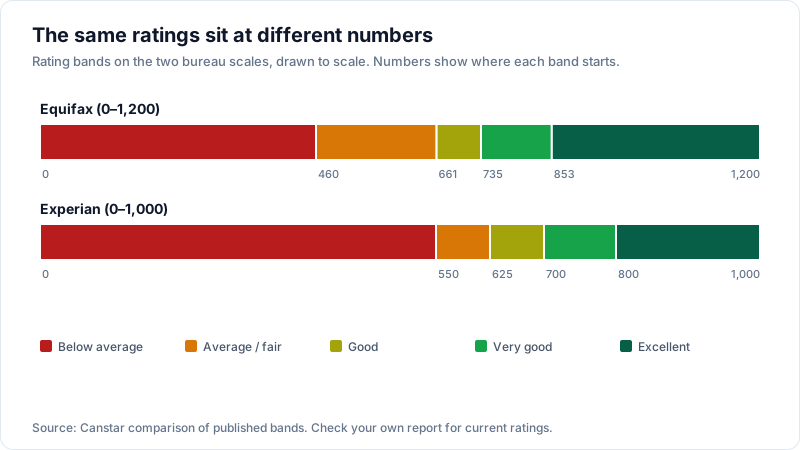
Because the scales differ, it is normal to have a different number from each bureau on the same day. Canstar's comparison of the published bands shows:
| Rating | Equifax (0–1,200) | Experian (0–1,000) |
|---|---|---|
| Below average | 0–459 | 0–549 |
| Average / fair | 460–660 | 550–624 |
| Good | 661–734 | 625–699 |
| Very good | 735–852 | 700–799 |
| Excellent | 853–1,200 | 800–1,000 |
Source: Canstar, a third-party comparison site. Bureaus can change their bands, so check your own report for the current ratings.
These bands help you see where you stand, but they do not set a pass mark. Each lender decides its own criteria for approving a loan, and your score is only one input.
What Is on Your Credit Report
According to Moneysmart, your credit report records:
- Personal details: name, date of birth, address history, employer and similar details.
- Credit products and repayment history: the products you held in the last two years, with limits, dates, and missed payments (those not made within 14 days of the due date).
- Financial hardship arrangements: these show only for the relevant months and are deleted after 12 months. Moneysmart says they do not affect your score.
- Defaults: unpaid debts reported by a service provider, which stay for five years, or seven years for a "clearout" where the provider cannot contact you. Paying a default does not remove it, but the report shows it as paid.
- Credit applications: the number you have made and the total credit borrowed, including any loans you have guaranteed.
- Bankruptcies and court judgments, and a record of lenders checking your report.
What Moves Your Score
Moneysmart lists three main factors: how much you have borrowed, the number of credit applications you have made, and whether you pay on time. That is why the habits below matter.
A Worked Example: One Missed Payment
Say your credit card minimum repayment is due on the 1st of the month and you forget. If the payment is made within 14 days of the due date, it is not listed as missed. If it is still unpaid after that, it can appear in your repayment history as a missed payment, and this record is part of the last two years of history that lenders can see. This is why setting up automatic payments is the easiest protection.
How to Protect and Improve Your Score
- Automate minimum repayments. A direct debit for at least the minimum payment on every credit card and loan means you avoid missed payments. You can always pay more manually.
- Space out applications. Moneysmart lists the number of credit applications as a factor, so avoid applying for several products in a short period.
- Think about unused credit limits. Many lenders consider the limit on a card, not only the balance, when they assess how much you can borrow. If you do not need a high limit, ask your lender about reducing it before you apply for a large loan. We have not found an official source that sets out how each lender treats limits, so ask yours.
- Check your report at least once a year. You can get a free copy of your credit report every three months, and Moneysmart recommends getting one at least once a year. Check that every account listed is yours and that your personal details are correct.
If Something Is Wrong
Fixing mistakes is free. Contact the credit reporting agency or the lender directly. If you cannot reach agreement, the Australian Financial Complaints Authority offers free dispute resolution, so you do not need to pay a credit repair firm (Moneysmart). Only incorrect information can be removed.
If you see debts you do not recognise, you may be a victim of identity theft. Moneysmart says you can request a temporary ban on your report to prevent unauthorised credit applications. Be wary of any online credit score provider that asks you to pay or for your card details.
Note: the score bands and rules above are correct as at 11 October 2026 and can change. Please check each bureau and Moneysmart for the latest information.
Interactive: Credit Score Checker Tool
Note: As an educational platform, we cannot pull your live credit score. The widget below helps you estimate your credit health based on common Australian reporting factors.
📊 Credit Score Health Estimator
Answer a few questions to estimate your Equifax credit band and get personalized tips.
Your Estimated Credit Health
Based on the 0-1200 Equifax scale.