Debt Avalanche vs. Debt Snowball Method
By Dr KH Asadul · Last reviewed 11 October 2026 · General information only, not personal advice
When you are juggling multiple debts—a car loan, a credit card, and a personal loan—making random extra payments across all of them is the slowest way to get out of debt.
Debt Avalanche vs. Debt Snowball Method
When you are juggling several debts, such as a car loan, a credit card and a personal loan, making random extra payments across all of them is the slowest way to get out. To clear debt faster, make the minimum required payments on all your loans, then channel your extra money toward just one target debt. Once that debt is gone, roll the money you were paying on it into the next one.
The question is which debt to target first. There are two well-known strategies.
Step Zero: Know What You Owe
Before choosing a method, list every debt with its balance, interest rate, fees (including early repayment penalties), remaining term and monthly repayment. Then work out how much you can put toward debt each month after covering essentials like rent or mortgage, utilities and any car repayment you need for work. Moneysmart sets out the same steps, and the amount left over is your monthly "debt money" (Moneysmart).
Method 1: The Debt Avalanche (The Mathematical Approach)
The Avalanche method focuses on saving you the most money. It ignores the size of your loans and looks only at the interest rate.
- How it works: List your debts from the highest interest rate down to the lowest. Your highest-rate loan becomes your target, regardless of how big the balance is.
- The Pros: Because you are attacking the debt that charges you the most, you pay the least interest overall. Moneysmart describes the same idea: pay the minimum on every debt and put the extra toward the one with the highest fees and interest.
- The Cons: It can be a long slog. If your highest-interest debt is a large credit card balance, it might take a year or more to cross the first debt off your list. You need discipline to keep going while progress feels slow.
Method 2: The Debt Snowball (The Motivational Approach)
The Snowball method ignores interest rates and focuses on the size of the balance to give you quick wins.
- How it works: List your debts from the smallest balance to the largest. Your smallest debt becomes your target.
- The Pros: You see results early. Clearing a $500 or $1,000 debt might take only a month or two, and that momentum can keep you going. Each cleared debt frees up its repayment, so your payments on the next one grow.
- The Cons: Because you ignore interest rates, you will usually pay more to the lender over time.
A Worked Example
These figures are hypothetical and rounded. Suppose you have three debts:
| Debt | Balance | Interest rate | Minimum per month |
|---|---|---|---|
| Store card | $1,500 | 10% | $60 |
| Credit card | $6,000 | 22% | $180 |
| Car loan | $14,000 | 8% | $330 |
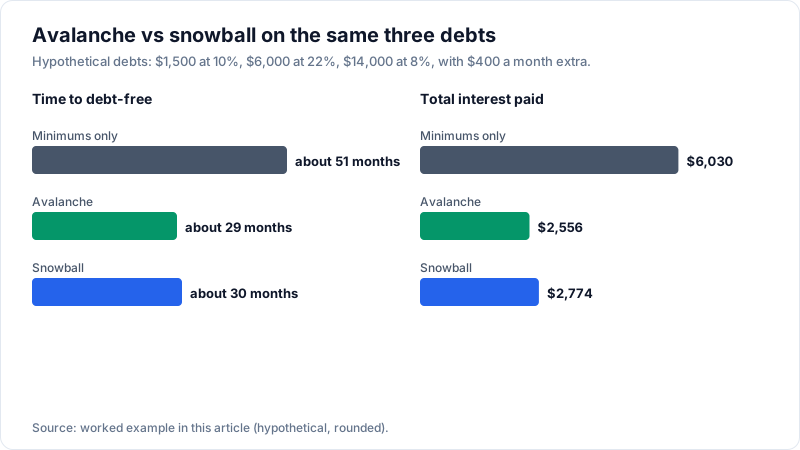
You can add $400 a month on top of the minimums. Here is how the methods compare:
| Method | Debt-free in | Total interest paid |
|---|---|---|
| Minimums only (no extra) | about 51 months | about $6,030 |
| Avalanche (credit card first) | about 29 months | about $2,556 |
| Snowball (store card first) | about 30 months | about $2,774 |
Both methods beat minimums-only by a wide margin. In this example the difference between them is roughly $218 and one month, because the interest rates are not far apart. The further apart your rates are, and the larger the high-rate balance, the more the Avalanche saves.
Which One Should You Choose?
- Choose the Avalanche if you have a large balance at a high rate, such as a credit card, and you stay motivated by long-term numbers.
- Choose the Snowball if you are stressed or overwhelmed, or have given up on budgets before because they felt too hard. A small extra cost in interest can be worth it if early wins are what keep you going.
- Try a hybrid: clear one very small debt first for a quick win, then switch to the Avalanche order.
The best method is the one you will keep doing. A plan you follow beats a perfect plan you abandon.
Balance Transfers and Consolidation
Two tools can lower the interest you pay, but both need care.
- Balance transfers. You move debt from a high-interest card to one with a low or 0% rate for a promotional period, often 6 to 24 months. There is usually a one-off transfer fee. Watch for new purchases being charged at a much higher rate, and for any balance remaining when the promotion ends, which is charged at a higher rate. Missing a required repayment can also cost you the low rate (Moneysmart).
- Consolidation. Combining several debts into one loan gives you a single repayment, but check the pros and cons first to confirm that you would actually save money.
Keeping the Plan on Track
- Automate your minimum repayments and your extra payment on payday.
- Avoid new debt while you pay down the old, including more credit card spending.
- Set a reminder for the end of any promotional rate period.
- Review monthly, and when a debt is cleared, move its full repayment to the next target.
If You Are Struggling
If you cannot meet your repayments, contact your lender early to ask about financial hardship support. The free National Debt Helpline (1800 007 007) offers financial counselling and can help you plan (National Debt Helpline).
Interactive: Debt Payoff Simulator
See how the two strategies compare using your actual numbers. Enter your debts below to see the difference in total interest paid and time to debt-free.
⚔️ Debt Payoff Simulator
Compare the Avalanche vs. Snowball method with your actual loans.
Money to throw at your target debt every month.
| Debt Name | Balance | Rate (% p.a.) | Min Payment | Remove |
|---|---|---|---|---|
$ | % | $ | ||
$ | % | $ | ||
$ | % | $ |
Debt Avalanche
Focuses on saving you the most money by targeting the highest interest rate first.
Debt Snowball
Focuses on quick psychological wins by targeting the smallest balance first.