The "Interest-Free" Trap (Instalments, 0% Cards & Cash Advances)
By Dr KH Asadul · Last reviewed 11 October 2026 · General information only, not personal advice
How to convert any "interest-free" offer's hidden flat fee into a real effective interest rate — before you agree to it, not after.
"Interest-free" means you are not charged interest. It does not mean the deal is free. Fees can still apply, and the deal can end with a large interest charge. This article covers instalment deals, buy now pay later (BNPL) and credit card cash advances, and shows how to turn a fee into a rate you can compare.
What "Interest-Free" Can Still Cost
Moneysmart, the government's consumer finance site, says fees may apply to an interest-free deal even though no interest is charged. These can include establishment, payment processing, account keeping, annual card and late fees, and they may be added to the amount you borrow. Some deals require a store card or credit card, and the retailer usually isn't the lender, so check your contract. Moneysmart's advice is to work out the total cost, including fees, before you sign up (Moneysmart).
A Real Case
On 28 July 2026 the Federal Court ordered Harvey Norman Holdings to pay a $35 million penalty and Latitude Finance Australia to pay $20 million. The court found that national advertising for a no-deposit, 60-month interest-free payment method at Harvey Norman, Domayne and Joyce Mayne stores was misleading. The ads ran from 1 January 2020 to 11 August 2021 and did not make clear that customers needed a linked GO Mastercard credit card and would pay establishment and monthly account fees (Federal Court of Australia).
ASIC said a customer who signed up between 16 March and 11 August 2021 and paid off a 60-month purchase would have owed at least $537 in fees on top of the price. This is one case about one campaign, not a finding about every retailer. It shows why the fee schedule matters more than the headline.
Turn the Fee Into a Rate
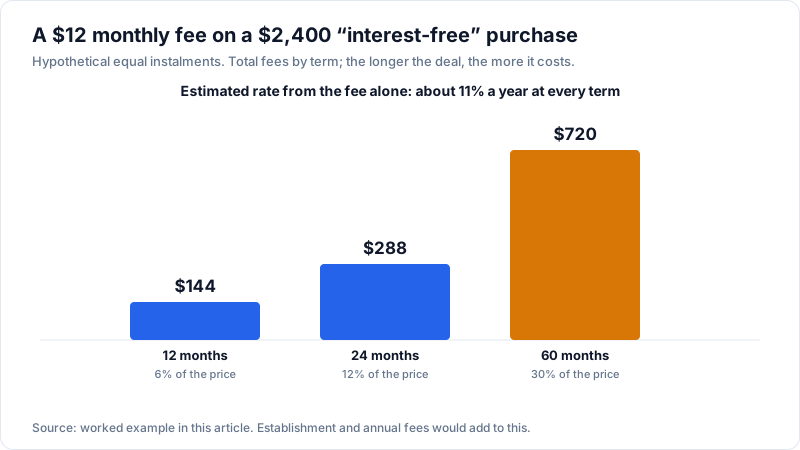
Here is a hypothetical $2,400 purchase paid in equal instalments with a $12 monthly fee:
| Term | Monthly payment | Total fees | Fees as a share of the price | Estimated annual rate |
|---|---|---|---|---|
| 12 months | $212 | $144 | 6% | about 10.9% |
| 24 months | $112 | $288 | 12% | about 11.1% |
| 60 months | $52 | $720 | 30% | about 10.8% |
The rate is the interest rate that makes the payments match the amount borrowed, worked out from the fee alone. In this example it is about 11% a year at every term. What changes is the total: a longer term means more fees, so the 60-month deal costs $720 for a $2,400 purchase. A flat fee can look small month to month and still add up to a large share of the price.
Compare the result with the rate on a credit card or personal loan, and with the option of saving up first. The rate here does not include any other fees, such as establishment or annual fees, so add them to your own calculation.
When the Interest-Free Period Ends
Moneysmart says that at the end of the period interest may be charged on any remaining balance, at rates as high as 29%, and the lender doesn't have to remind you when the period ends. If you make only the minimum repayments, they may not clear the balance in time. Its tips are to divide the balance by the number of promotional months and pay that amount each month, track the end date, check your statements, and avoid extra spending on the linked account.
Buy Now Pay Later
Moneysmart says BNPL lets you pay in instalments. You usually don't pay interest, but you may be charged late fees, monthly account-keeping fees, payment processing fees or establishment fees. Each application triggers a credit check, and late or missed payments can be reported and lower your score (Moneysmart).
BNPL providers have been regulated under credit law since the Treasury Laws Amendment (Responsible Buy Now Pay Later and Other Measures) Act 2024, which received royal assent on 10 December 2024. ASIC said providers needed a credit licence from 10 June 2025 (ASIC). Moneysmart's tips include setting a spending limit, using one service at a time, budgeting for the payments, and linking the account to a debit card to avoid credit card interest.
Credit Card Cash Advances
Moneysmart's glossary says a cash advance is money withdrawn from a credit card account. It typically costs you a transaction fee, and interest starts on the withdrawal date and continues until the full amount is repaid (Moneysmart). Check your card's terms for the exact fee and rate, because they vary.
Alternatives and Help
Moneysmart lists No Interest Loans for low-income households, lay-by and saving up as alternatives. Lay-by can be cheaper because it has no account-keeping or late fees. If you cannot keep up with repayments, contact the lender about hardship, or call the National Debt Helpline on 1800 007 007 for free financial counselling.
Next Steps
Before you agree to an interest-free deal, ask for the total cost over the full term and the interest rate that applies afterwards, then put the fee into the calculator below. If the seller won't state the total, treat that as a reason to walk away. Taking on credit also affects your credit file, which our article on credit scores explains.
Examples are hypothetical. Rules, rates and fees change, so check the linked sources before you act.
⚠️ Effective Interest Rate Calculator
Estimate the annual rate behind a flat monthly fee on an "interest-free" deal. Estimates only.
This is what you pay on top of the original purchase price.
Worked out from the monthly fee alone, assuming equal instalments. It excludes establishment or annual fees and any interest after the deal ends. Compare it with the rate on a credit card or personal loan.