High-Interest Savings Accounts (HISAs) & Conditions
By Dr KH Asadul · Last reviewed 11 October 2026 · General information only, not personal advice
You have done the hard work of saving your money. Now, you need your money to work for you. In Australia, placing your savings in a standard everyday transaction account means it is earning almost 0% interest and actually losing value against inflation.
High-Interest Savings Accounts (HISAs) & Conditions
You have done the hard work of saving the money. The next question is where it sits. A High-Interest Savings Account (HISA) is a savings account that pays a much higher rate than a standard everyday account, but only if you meet the bank's conditions. Banks do not offer these rates out of goodwill, and the conditions are designed to make you use them as your primary bank.
What Rates to Expect
Savings rates in Australia follow the RBA's cash rate, although each bank sets its own. As at 11 October 2026, comparison site Finder lists maximum total rates of roughly 4.75% to 6.25% p.a. across the accounts it tracks, and the highest figures are introductory rates for new customers. Many bonus-driven accounts have a base rate of 0% to 0.05%, while some others pay a few per cent without conditions (Finder, rates checked 10 October 2026).
Note: these figures are correct as at 11 October 2026 and change often, particularly after an RBA board meeting (the cash rate target was 4.60% from 29 September 2026; see the RBA cash rate page). Please check a current comparison and the bank's own product page before you decide.
The "Base Rate" vs. The "Bonus Rate"
When you look at advertised interest rates in Australia, you are almost always looking at a Total Variable Rate, which is split into two parts:
- The Base Rate: This is the standard interest rate you earn just for having the money in the account. It is often very low, for example 0.05% or 0.10%.
- The Bonus Rate: This is the higher interest you earn only if you meet the bank's specific monthly requirements.
If you fail to meet the conditions in any given month, your rate drops down to the Base Rate. The bank will not warn you. It is entirely on you to track the requirements.
A Worked Example
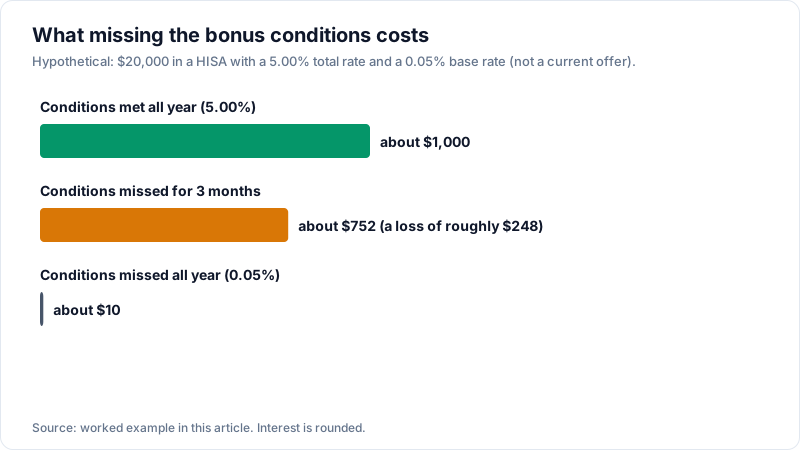
Say you have $20,000 in a HISA with a 5.00% total rate and a 0.05% base rate. These are illustrative figures, not a current offer.
| Scenario | Annual interest on $20,000 |
|---|---|
| Conditions met all year (5.00%) | about $1,000 |
| Conditions missed all year (0.05%) | about $10 |
| Conditions missed for 3 months | about $752 (a loss of roughly $248) |
One forgotten monthly deposit can cost you more than a month of effort is worth, which is why it pays to automate the conditions rather than rely on memory.
The Common "Hoops" (Bonus Conditions)
To unlock the maximum advertised rate, most Australian banks require you to meet one or more of the following conditions by the last business day of the month:
- The Deposit Condition: You must deposit a minimum amount from an external source (for example $500 or $1,000 per month). Your salary usually covers this.
- The Growth Condition: Your account balance at the end of the month must be higher than it was at the start of the month (excluding the interest paid by the bank).
- The Transaction Condition: You must make a set number of purchases (for example 5 or 10) using a linked debit card.
- The Withdrawal Limit: You must make zero withdrawals (or a limited number) during the month.
The Hoops People Miss
Beyond the headline conditions, check the fine print for these:
- Balance caps. Some accounts pay the bonus rate only on balances up to a limit, with a lower rate on anything above it.
- Linked accounts. Some savings accounts require a linked transaction account with the same provider.
- Age limits and eligibility. Some of the highest rates are restricted to certain age groups.
- Fees and how interest is paid. Check for monthly fees and whether interest is paid monthly or at another interval.
- Authorised deposit-taking institutions. Moneysmart lists whether the provider is an authorised deposit-taking institution (ADI) as something to compare, because ADIs are covered by the guarantee described below.
Introductory ("Honeymoon") Rates vs. Ongoing Rates
Be careful of accounts advertising exceptionally high rates. Often, these are introductory rates that only last for the first 3 or 4 months after you open the account. Once the "honeymoon" period ends, the rate drops to a standard rate that can be much lower than the market average. Moneysmart's advice is to check what the rate will be after the introductory period ends.
When comparing HISAs, focus on the maximum ongoing bonus rate, not just the temporary welcome rate, unless you are willing to switch banks every few months.
Is Your Money Safe?
Deposits with Australian banks, building societies and credit unions are protected by the Australian Government's Financial Claims Scheme, up to $250,000 per account holder per institution if the institution fails. APRA, which administers the scheme, says it aims to return deposits within seven days of the scheme being activated, though that is a target and not a guarantee (APRA). If you hold more than $250,000 in total, spreading it across institutions keeps each balance inside the cap.
Tax on the Interest
Interest is income. You declare interest from Australian accounts in your tax return, and the amount is taxed at your marginal rate. For joint accounts, the interest is split between the holders, equally unless you actually share it differently. If you did not give your bank a tax file number, tax may have been withheld from your interest, and you report that amount as part of your gross interest (ATO).
A Quick Checklist Before You Switch
- Find the ongoing rate, not only the introductory one, and what it drops to after the introductory period.
- List the conditions and ask whether you will meet them every month without effort.
- Check for a balance cap against the amount you plan to save.
- Confirm the provider is an ADI if you want the deposit guarantee.
- Automate the conditions (a scheduled deposit, a recurring debit card payment) so one slip does not cost you the bonus.
- Set a calendar reminder for the end of any introductory period, and compare again then.
Interactive: HISA Condition Checker
Are the hoops worth the high rate? Use the tool below to see how much interest you actually lose if you miss your bank's bonus conditions for a few months.
🏦 HISA Condition Checker
Calculate the true cost of missing your bank's bonus conditions.
Perfect! You are maximizing your high-interest savings account.