The Basics of Negative Gearing (Property & Shares)
By Dr KH Asadul · Last reviewed 11 October 2026 · General information only, not personal advice
When you borrow money to buy an investment asset (like a rental property or a portfolio of shares), that asset generates income (rent or dividends), but it also costs you money (loan interest, council rates, maintenance).
The Basics of Negative Gearing (Property & Shares)
Gearing means borrowing money to invest. An investment is positively geared if it earns more income than it costs to run, and negatively geared if it costs more than it earns. A negatively geared investment makes a cash loss each year. This article explains how that has worked, what changes from 1 July 2027 for residential property, and what stays the same for shares. It is general information as at 11 October 2026.
How Negative Gearing Has Worked
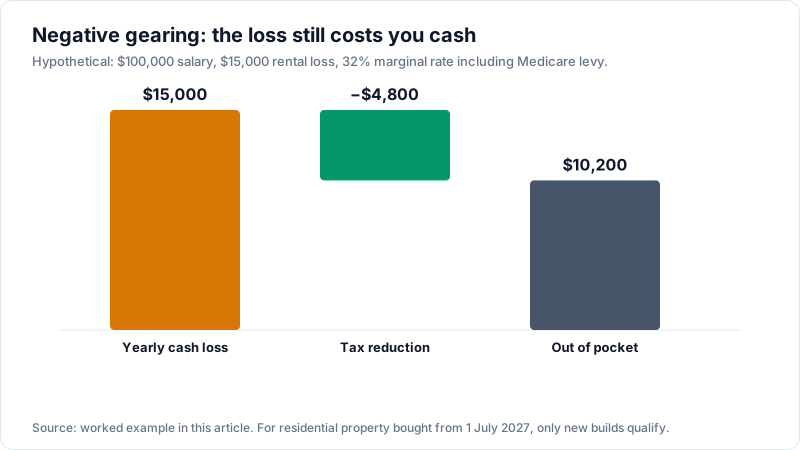
Until now, a loss on an investment could be deducted from your other income, including your salary. Here is a hypothetical example. You earn $100,000, and your investment property loses $15,000 a year after the mortgage interest is higher than the rent. Your taxable income falls to $85,000. At a 32% marginal rate (30% plus the 2% Medicare levy), the tax reduction is $4,800. The loss still costs you $10,200 in cash, so the strategy only pays if the property's growth more than covers the shortfall, and growth is not guaranteed.
What Changes From 1 July 2027
The ATO says the Government's negative gearing and capital gains tax measures, announced in the 2026–27 Budget on 12 May 2026, are now law and apply from 1 July 2027. Losses on residential property investments are limited to new builds (ATO).
The Budget explainer adds these details (Budget 2026–27):
- Existing residential properties bought from 7:30pm AEST on 12 May 2026 can only use losses to offset other residential property income, including capital gains. They can no longer reduce salary or wages. Excess losses carry forward to offset future residential property income.
- Who is covered. Individuals, partnerships, companies and most trusts. Widely held trusts and super funds, including SMSFs, are excluded.
- Not affected. Commercial property and other asset classes, including shares, keep their existing arrangements.
Grandfathering
| When you bought | Negative gearing |
|---|---|
| Held at the announcement (7:30pm AEST, 12 May 2026), including contracts entered into but not settled | Continues until the property is sold |
| Bought after the announcement and by 30 June 2027 | Continues until 30 June 2027 only |
| Bought from 1 July 2027 | Not available, unless it is a new build |
What Counts as a New Build
According to the Budget explainer:
- Eligible. Dwellings built on vacant land, and demolition and replacement that increases the number of dwellings. Examples include off-the-plan apartments and a duplex replacing a single house.
- Not eligible. Knock-down rebuilds or renovations that don't add dwellings, and extensions to established properties.
- Resale. A new build cannot have been previously sold, unless it was first owned by the builder and unoccupied for more than 12 months. Later buyers of a new build cannot use negative gearing or the 50% CGT discount for that property.
Definitions can be clarified over time, so check the ATO's reform page for how they apply to a particular property.
Shares and Other Investments
The Budget explainer says shares keep their existing negative gearing arrangements. If you borrow to invest in shares or ETFs and the interest is higher than the income you receive, the loss can still be deducted against your other income, as before.
Borrowing to invest carries real risk. Moneysmart says borrowing increases the amount you lose if your investments fall, that you can lose a lot more than you invest, and that you must repay the loan and interest regardless of how your investment performs (Moneysmart). Tax savings do not remove that risk.
Keeping Records
The ATO explains which rental expenses you can claim and what records to keep for a rental property (ATO). A registered tax agent can advise on your own circumstances.
Next Steps
Use the simulator below to see how a loss changes your out-of-pocket cost for a property bought from 1 July 2027. If you are weighing up an investment property, our article on buying an investment property covers the full costs and risks, and the CGT article explains how the sale of a property is taxed.
This is general information as at 11 October 2026, not tax or financial advice. Rules and definitions may change, so check the ATO website before you decide.
🏠 The 2027 Negative Gearing Cashflow Simulator
Illustrate how a rental loss affects your out-of-pocket cost for a property bought from 1 July 2027. Grandfathered properties and carry-forward losses are not modelled.
The new 2027 laws prohibit negative gearing deductions against your salary for existing homes.
⚠️ $0 Refund. Because this is an established home, the 2027 laws prohibit you from deducting this loss against your salary. The loss is "quarantined" for the future.