Micro-investing Apps (Raiz, Spaceship, Pearler)
By Dr KH Asadul · Last reviewed 11 October 2026 · General information only, not personal advice
Micro-investing apps help you start small, but flat monthly fees weigh heavily on small balances. Here is how Raiz, Spaceship and Pearler Micro compare, and what to ask before you sign up.
Micro-investing Apps (Raiz, Spaceship, Pearler)
Micro-investing apps let you start with small amounts, often by rounding up everyday purchases or setting up a small regular transfer. They can help build the habit of investing, but small balances and flat fees do not mix well. This article compares Raiz, Spaceship Voyager and Pearler Micro using each provider's own fee pages as at 11 October 2026, and sets out the questions Moneysmart suggests you ask first. It is general information, not a recommendation of any provider.
What Micro-investing Apps Do
Moneysmart says you open an account, add money manually or automatically, choose one or more investment options, and the provider invests your money accordingly. Some apps invest directly in shares or ETFs, and others use managed funds or model portfolios. Features can include regular automatic investing and rounding up everyday purchases (Moneysmart).
Moneysmart also lists fees to check, including transaction or brokerage fees, subscription fees, currency exchange fees, transfer fees and withdrawal fees, and says fees can have a larger effect on returns when amounts are small.
Who Owns Your Investments?
Moneysmart's first warning is about ownership. If the provider directly owns the investments, you generally can't buy and sell on the market yourself, and if the provider goes bust, getting your money back may be long and complex. It suggests five questions to ask before you open an account: what you are investing in, how the app works, who owns the investments, what fees you'll pay, and whether it fits your long-term goals.
| Raiz | Spaceship Voyager | Pearler Micro | |
|---|---|---|---|
| What you hold | Units in a registered managed investment scheme that buys ETFs | Units in a managed fund (unit trust) that invests in shares | Units in a managed fund (the Pearler Investors Fund) that holds ETFs |
| Who holds the assets | An independent custodian, according to Raiz | The fund | The fund |
| Choice of investments | Preset portfolios, with custom options on higher plans | Three portfolios chosen by Spaceship | Up to 8 managed fund options |
| Moving to another broker | Check the PDS | Check the PDS | Generally not offered. You sell, withdraw and reinvest |
Sources for the table: Raiz's custodian article is from 2018 and was last updated in 2020, so check the current Product Disclosure Statement (PDS) before relying on it (Raiz). Spaceship describes Voyager as managed funds that invest directly in shares, with your money buying units under a unit trust structure (Spaceship). Pearler says micro-investing means holding fund units rather than shares, that share transfers to another broker generally aren't offered, and that voting rights typically aren't passed on (Pearler).
The Three Providers
Raiz. Known for its round-up feature, where a purchase is rounded up and the difference is invested. Raiz lists a Lite plan at $2.50 a month (moved to Regular when the balance passes $1,500), Regular from $5.50 a month and Plus from $6.50 a month. Regular and Plus also list a 0.275% a year fee on balances above $26,000 and $28,000 respectively. It says withdrawals are unlimited with no withdrawal fees (Raiz).
Spaceship Voyager. Spaceship charges $3 a month if you hold at least one portfolio with a balance of $100 or more, plus a management fee of 0.15% (Origin), 0.25% (Explorer), 0.35% (Galaxy) or 0.50% (Universe and Earth). It says there are no brokerage, operational or withdrawal fees (Spaceship). The portfolios differ. Spaceship describes Origin as rules-based, covering about 100 of the largest Australian and about 100 of the largest international companies across all sectors. Universe holds 70 to 100 companies chosen under its "Where the World is Going" criteria, with a growth and technology focus, and Earth focuses on companies with a positive impact. A sector-focused portfolio can be more volatile than a broad one.
Pearler Micro. Pearler charges a flat $2.00 a month for Micro, with the first two months free. Its separate share-trading product charges $6.50 per ASX trade (Pearler). Micro is a managed fund product, while Pearler's share product is a different, CHESS-sponsored service, so check which one you are using.
How Fees Compare on Small Balances
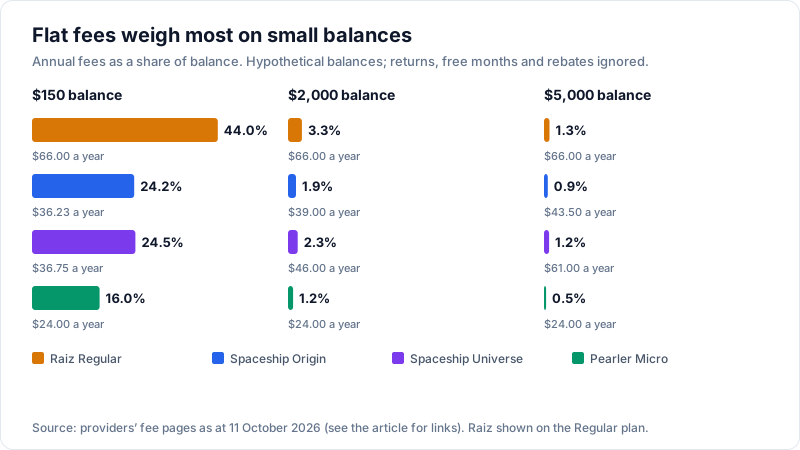
Here is a hypothetical comparison of annual fees on three balances, using the fees above. It ignores investment returns, the first two free months at Pearler and any Raiz rebate, and assumes the Raiz Regular plan.
| Annual fees (share of balance) | $150 balance | $2,000 balance | $5,000 balance |
|---|---|---|---|
| Raiz Regular | $66.00 (44.0%) | $66.00 (3.3%) | $66.00 (1.3%) |
| Spaceship Origin (0.15%) | $36.23 (24.2%) | $39.00 (1.9%) | $43.50 (0.9%) |
| Spaceship Universe (0.50%) | $36.75 (24.5%) | $46.00 (2.3%) | $61.00 (1.2%) |
| Pearler Micro | $24.00 (16.0%) | $24.00 (1.2%) | $24.00 (0.5%) |
The same flat fees take a much larger share of a $150 balance than of $5,000. Raiz Regular's $66 a year is 44% of $150 and 3.3% of $2,000. Compare that with buying an ETF or index fund through a broker, where you pay a management fee inside the fund and may pay brokerage each time you trade. Check the current fees before you decide.
Risks and Alternatives
Moneysmart says micro-investing carries the same risks as other investing, including market, sector, liquidity, credit, inflation and timing risks. On top of that you carry provider and structure risk, and the exit cost: moving money between providers can mean selling, possibly paying capital gains tax, and reinvesting.
If your balance grows, you may prefer to buy ETFs directly through a low-cost broker. Our articles on ETFs and index funds and on how shares are held (CHESS and custodial) explain the options. Moneysmart's advice is to check whether the fees are reasonable for the amount you will invest and how they compare with other providers or brokers.
Next Steps
Ask the five Moneysmart questions of any app you are considering, read its PDS, and use the calculator below with your own balance and an assumed return. Fees change often, so check each provider's fee page before you sign up.
Fees are as at 11 October 2026, taken from each provider's own pages. Examples are hypothetical. This is general information, not financial advice.
📱 The Micro-Investing Fee Calculator
Estimate how flat monthly fees compare with a small balance. Fees are as at 11 October 2026 and change often, so check each provider's fee page.
Try testing a low balance (e.g. $150) vs a high balance (e.g. $5,000).
Fees assumed:
From $5.50 a month ($66/year).
On these assumptions the fees are higher than your assumed return, so the account would lose money in a year at this balance.