Capital Gains Tax (CGT) Basics & The 2027 Reforms
By Dr KH Asadul · Last reviewed 11 October 2026 · General information only, not personal advice
When you buy a share for $10 and sell it a few years later for $50, you have made a $40 profit. In Australia, the Australian Taxation Office (ATO) wants a cut of that profit. This is called Capital Gains Tax (CGT).
Capital Gains Tax (CGT) Basics & The 2027 Reforms
Capital gains tax is not a separate tax. If you make a $4,000 capital gain on your shares, the gain is added to your taxable income for the year and taxed at your marginal rate. This article explains how CGT works, what the 2027 reforms change, and how capital losses help, using the ATO and the 2026–27 Budget explainer. The rules in this article are as at 11 October 2026.
When CGT Applies
You only have a capital gain or loss when a CGT event happens, which usually means selling the asset. Shares sitting in your account that rise in value are not taxed until you sell. Under the classic rules, an individual who holds an asset for more than 12 months receives a 50% discount, so the ATO adds only half of the gain to your taxable income. For example, a $10,000 profit on an ETF held for more than 12 months adds $5,000 to your taxable income.
What Changes From 1 July 2027
The ATO says the Government's negative gearing and capital gains tax measures, announced in the 2026–27 Budget on 12 May 2026, are now law and apply from 1 July 2027. For CGT, the 50% discount for individuals, trusts and partnerships is replaced by cost base indexation and a 30% minimum tax rate on gains (ATO).
According to the Budget explainer (Budget 2026–27):
- Indexation. Cost base indexation, based on CPI, replaces the 50% discount from 1 July 2027. It applies to assets held at least 12 months, including property and shares.
- Minimum tax. A 30% minimum tax applies to real capital gains that accrue from 1 July 2027, and is taxed only when the gain is realised. It does not affect taxpayers who are already taxed at 30% or more.
- Exemption. People who receive a means-tested income support payment, such as the Age Pension or JobSeeker, in the financial year the gain is realised are exempt from the minimum tax.
- Unchanged. The main residence exemption, the four small business CGT concessions and the 60% discount for qualifying affordable housing.
What Happens to Assets You Already Own
| When you buy and sell | Treatment |
|---|---|
| Bought and sold before 1 July 2027 | No change |
| Bought on or after 1 July 2027 | Fully under the new rules |
| Bought before 1 July 2027, sold after | Gains up to 1 July 2027 keep the 50% discount. The value at 1 July 2027 becomes the new cost base, and later gains use indexation and the minimum tax |
For shares you can use quoted prices to establish the 1 July 2027 value, and the explainer says other taxpayers can get a valuation or use an ATO apportionment formula. Original purchasers of new-build residential property can choose either the 50% discount or indexation with the minimum tax. Later buyers of that property cannot use the 50% discount.
Is Indexation Better or Worse?
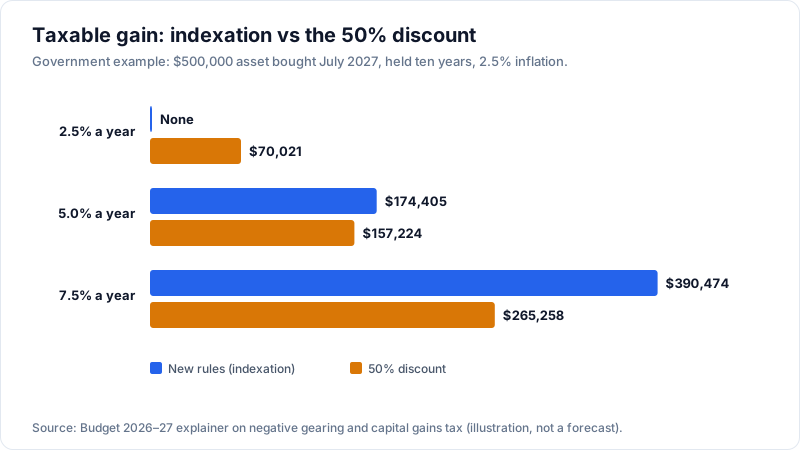
It depends on how much the asset grows compared with inflation. The Budget explainer gives these examples, using a $500,000 asset bought in July 2027, held for ten years with 2.5% inflation:
| Annual return | Taxable gain, new rules | Taxable gain, 50% discount | Difference in tax |
|---|---|---|---|
| 2.5% | None | $70,021 | $24,858 less tax |
| 5.0% | $174,405 | $157,224 | $8,075 more tax |
| 7.5% | $390,474 | $265,258 | $58,851 more tax |
In short, indexation helps when returns are close to inflation, and costs more when returns are well above it. The explainer's share example is small: shares bought for $100 on 1 July 2027 and sold for $125 on 1 July 2032 have an indexed cost base of $113, so the taxable gain is $12, compared with about $13 under the 50% discount. These are Government illustrations, not forecasts, and your own result depends on your tax rate and the return you actually earn.
Capital Losses
If you sell an asset for less than its cost, you make a capital loss. The ATO says you use current-year capital losses to offset current-year capital gains, and that you should apply losses to gains that aren't eligible for the discount first, which gives the lowest CGT. Net capital losses can be carried forward with no time limit (ATO).
For example, if you make a $5,000 gain on one share and a $3,000 loss on another, you pay CGT on the remaining $2,000. Capital losses can't be deducted from other income such as salary, and losses on personal use assets can't be used at all.
Next Steps
Use the calculator below to test a purchase made on or after 1 July 2027. If you already own assets, the transition rule above applies, so keep your purchase records and consider getting a valuation near 1 July 2027. Details can change through regulations and ATO guidance, so check the ATO's reform page and consider a registered tax agent before you sell.
This is general information as at 11 October 2026, not tax advice.
⚖️ The 2027 CGT Reform Calculator
Compare the classic 50% discount with the new indexation and 30% minimum tax, for an asset bought on or after 1 July 2027. Illustration only: it does not model the transition for assets you already own or the income-support exemption.
The Old System is better for this scenario.
You pay $2,038 more in tax under the new rules, largely due to the 30% minimum tax or because your return was well above inflation, on these assumptions.