ETFs and Index Funds vs. Individual Shares
By Dr KH Asadul · Last reviewed 11 October 2026 · General information only, not personal advice
When you open your brokerage app to invest your hard-earned savings, you are immediately faced with thousands of options. The biggest decision you will make is whether you want to try and pick individual winning companies, or simply buy the entire market.
ETFs and Index Funds vs. Individual Shares
When you open your brokerage app to invest, you are faced with thousands of options. The biggest decision is whether you try to pick individual winning companies, or buy a broad slice of the market. This guide explains both so you can see the trade-offs. It is general information and not a recommendation to buy anything.
Individual Shares (Stock Picking)
Buying an individual share means you are investing directly in one company, like Commonwealth Bank, BHP or Woolworths.
- The appeal: If you pick a company before it grows strongly, the gains can be large.
- The reality: Picking winners consistently is hard, even for professionals (see the data below).
- The risk: If most of your money is in one company and something goes wrong, such as a commodity price crash or poor management, your losses can be severe. Moneysmart makes the same point: if you own shares in only one business, you could lose most or all of your money (Moneysmart).
Index Funds and ETFs (The Basket Approach)
An index is a tracking list of companies. The S&P/ASX 200 is a list of 200 of the largest companies listed in Australia, and the S&P 500 tracks 500 large US companies.
An exchange traded fund (ETF) is a managed fund that trades on a stock exchange. You buy units in a pooled fund rather than the underlying investments themselves, through a broker or investment platform, at the market price during trading hours (Moneysmart). Most Australian ETFs are passive, meaning they track an index such as the ASX 200, so their value moves with it. A physical ETF holds some or all of the index's assets.
A Worked Example
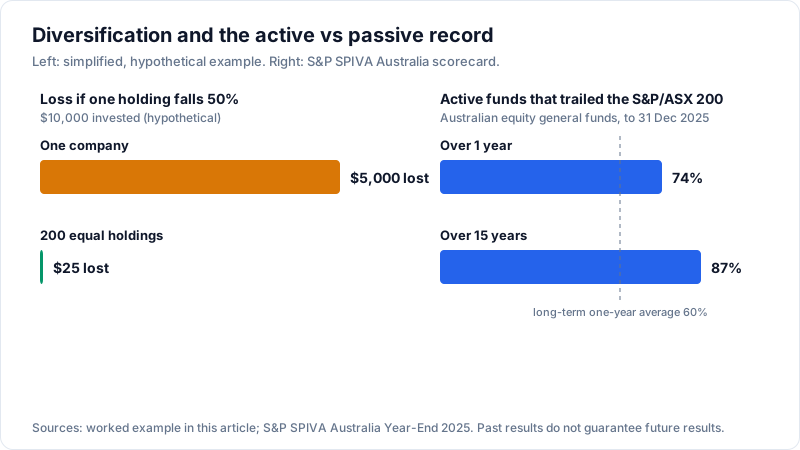
These figures are hypothetical, not a forecast. Suppose you invest $10,000 in one company and its shares fall 50%: you are left with $5,000. Now suppose you invest the same $10,000 in a fund holding 200 companies in equal amounts (real indexes are weighted by company size, so this is a simplification). If one of those companies falls 50%, your fund falls about 0.25%, or roughly $25. A broad fund does not stop you losing money when the whole market falls, but it reduces the damage from any single failure.
Diversification and Its Limits
Moneysmart describes diversification as spreading your money across different investments to reduce volatility. You can diversify across asset classes, within an asset class, and across countries (Moneysmart). A fund holding many companies gives you that spread in one purchase.
Be aware of concentration inside a "global" fund. MSCI's global index breakdown shows Australia at about 1.5% of the MSCI ACWI IMI index and the United States at about 62.7%, as at 30 June 2026 (MSCI). This means a fund tracking the whole world is heavily weighted to the US, and a fund that tracks only Australian shares leaves you with a small share of the world's listed companies. This is the share of listed companies, not of the world economy.
Active vs. Passive: What the Data Says
Active funds try to beat an index, and passive funds try to match it. S&P's SPIVA scorecard compares Australian active funds with their benchmark. To 31 December 2025, 74% of Australian equity general funds underperformed the S&P/ASX 200 over one year (the long-term average is 60%), and 87% underperformed over 15 years (S&P SPIVA). Past results do not guarantee future results, and some active funds do beat their benchmark, but most have not over long periods.
What an ETF Costs
- Management fees: Moneysmart says these are often low, but they vary by fund. Compare fees, since small differences compound over time (Moneysmart). Check the fund's product disclosure statement (PDS) for the exact figure.
- Brokerage and trading costs, paid when you buy and sell, which also affect your return.
What Can Go Wrong
ETFs are not risk-free. Moneysmart lists market risk, sector risk, currency risk for overseas assets, liquidity risk (trading can become harder or costlier), and manager risk. Synthetic ETFs, which use derivatives instead of holding the assets, carry counterparty risk, and complex ETFs that use borrowing can magnify losses as well as gains. The PDS sets out a fund's goals and risks. Moneysmart's page on ETFs does not cover tax, so check the PDS and the ATO for how distributions are taxed.
Rebalancing
Over time, your best performers become a larger share of your portfolio, which can raise its risk. Moneysmart says rebalancing, either by adding new money to the underweight areas or by selling some holdings, restores your intended mix, and selling may create a tax bill.
How to Choose
Moneysmart notes that higher potential returns usually come with higher risk, and that growth assets generally need at least five years (Moneysmart). Before buying an ETF, check:
- What index or strategy does it follow, and is it physical or synthetic?
- What are the total costs, including management fees and brokerage?
- Which markets and currencies does it expose you to?
- What does the PDS say about risks?
- Does it fit your time frame and goals? A fund held for under five years may not suit growth assets.
If you are unsure, consider speaking to a licensed financial adviser. For how your shares are held once you buy, see our guide to CHESS sponsorship and custodial accounts.
Note: the market weights and fund-performance statistics above are correct as at the dates stated and change over time.
Interactive: The Diversification Simulator
See the difference between single-stock risk and ETF diversification. Compare the potential journey of investing $10,000 into one single company versus spreading it across an ETF holding 500 companies.