Franking Credits Explained (The Refund Hiding in Your Dividends)
By Dr KH Asadul · Last reviewed 11 October 2026 · General information only, not personal advice
The uniquely Australian tax mechanic that can turn the same dividend into a very different after-tax outcome depending on who owns the shares.
Two people each buy $10,000 of the same Australian bank shares. The share price moves the same for both, and the dividend per share is the same. Yet the amount each person keeps after tax can differ, and franking credits are the reason.
What a Franking Credit Is
Australia has a dividend imputation system. Moneysmart describes a franking credit as your share of company tax that has already been paid on the profits you receive as a dividend or distribution. It can help prevent the same income being taxed twice, and it may reduce the tax you need to pay (Moneysmart).
The size of the credit depends on the tax rate the company paid. The ATO sets two company tax rates: 25% for base rate entities, which have aggregated turnover under $50 million and no more than 80% passive income, and 30% for other companies (ATO). A dividend can be fully franked, partly franked or unfranked. Your dividend statement shows the franked and unfranked amounts and the credit.
How It Reaches Your Tax Return
You include the dividend and its franking credit in your assessable income, which is called "grossing up". The credit then counts as tax already paid. If your tax on the grossed-up amount is more than the credit, you pay the difference. If it is less, and you are an Australian resident, the excess can be refunded.
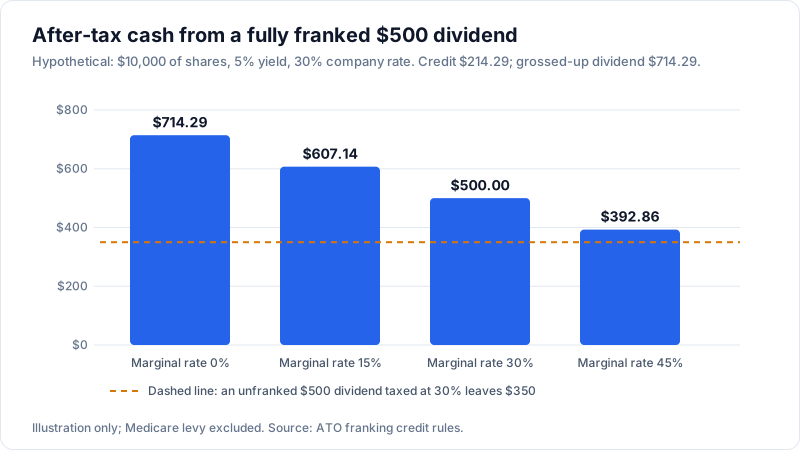
Here is a hypothetical example. You hold $10,000 of shares yielding 5%, fully franked at a 30% company rate. The cash dividend is $500. The credit is $500 x 30/70 = $214.29, so the grossed-up dividend is $714.29. The table shows the same dividend at four assumed marginal tax rates. It leaves out the Medicare levy.
| Marginal rate | Tax on $714.29 | Less credit | Net result | After-tax cash | After-tax yield |
|---|---|---|---|---|---|
| 0% | $0.00 | $214.29 | $214.29 refund | $714.29 | 7.14% |
| 15% | $107.14 | $214.29 | $107.14 refund | $607.14 | 6.07% |
| 30% | $214.29 | $214.29 | $0.00 | $500.00 | 5.00% |
| 45% | $321.43 | $214.29 | $107.14 tax | $392.86 | 3.93% |
For comparison, a $500 unfranked dividend taxed at 30% would leave $350. These are illustrations, and your own result depends on your total income and circumstances.
Who Can Get a Refund
The ATO says you may be eligible for a refund of franking credits if you received franked dividends on or after 1 July 2000, directly or through a trust or partnership, your basic tax liability is less than your franking credits after other tax offsets, and you meet the integrity rules. Australian residents can use credits to reduce tax on other assessable income, and any remaining credits are refunded after tax and Medicare levy liabilities are met (ATO).
The integrity rules include:
- Holding period rule. You must hold the shares at risk for at least 45 days (90 days for preference shares). The days you buy and sell are not counted. This rule applies if your total franking credit entitlement for the year is $5,000 or more.
- Small shareholder exemption. If your total entitlement is under $5,000, you don't need to meet the holding period rule. You must still meet the related payments rule.
- Related payments rule. This applies if you pass the benefit of the franked dividend to someone else, or are likely to. If it applies, you can't claim the offset.
If you can't claim credits for certain dividends, leave them out of your tax return. To claim, use the dividends question in myTax or the paper return. Keep your dividend statements and any trust or partnership distribution statements.
Rules like these can change, so check the ATO page before you act. Tax rules are specific to individuals and a registered tax agent can advise on your own case.
Funds and ETFs
The ATO page says credits can arrive through a trust or partnership, and your share appears on the distribution statement. If a statement shows no franking credits, the distribution is unfranked and you can't claim a credit. Funds that hold Australian shares may pass on credits, and funds that hold only overseas shares generally do not, because the companies pay tax elsewhere. Check your fund's own distribution statement to see what it actually passed on.
Franking credits are one factor when you compare an Australian share fund with a global one. They sit alongside diversification, fees and risk. Australia makes up a small share of global equities, so a portfolio concentrated in Australian shares carries different risks from a global one. Our article on ETFs and index funds looks at that choice.
Next Steps
Check your latest dividend statement to see the franked amount and credit. Then use the calculator below with your own figures, choosing the company tax rate that applies to the shares you hold. The calculator ignores the Medicare levy and the holding period rules, so treat its result as an illustration.
Figures are hypothetical. Tax rates and rules change, so check the linked sources before you act. This is general information, not tax advice.
🏛️ Franking Credit & After-Tax Yield Calculator
Illustrate how franking credits change the after-tax result. Excludes the Medicare levy and the holding period rules.
The dividend statement shows the franking credit, so check it against this estimate.