Verify Before You Invest
By Dr KH Asadul · Last reviewed 11 October 2026 · General information only, not personal advice
The most convincing financial pitch often comes from someone you already trust. Here is how to check an offer against public records, whoever introduced it.
Why Trust Is the Weak Point
Most people are careful with strangers. The pitches that work best often come from someone you already know: a friend, a colleague, a community group chat or an online contact you have started to trust. When that happens, the checking that would normally take place never does. Nobody wants to suggest that a friend has been fooled, or that they might be wrong.
This pattern is often called affinity fraud: trust from a relationship is borrowed to sell an offer that nobody has actually checked. The defence is to check the offer, not the person, using public records that don't depend on who introduced it.
How Big Is the Problem?
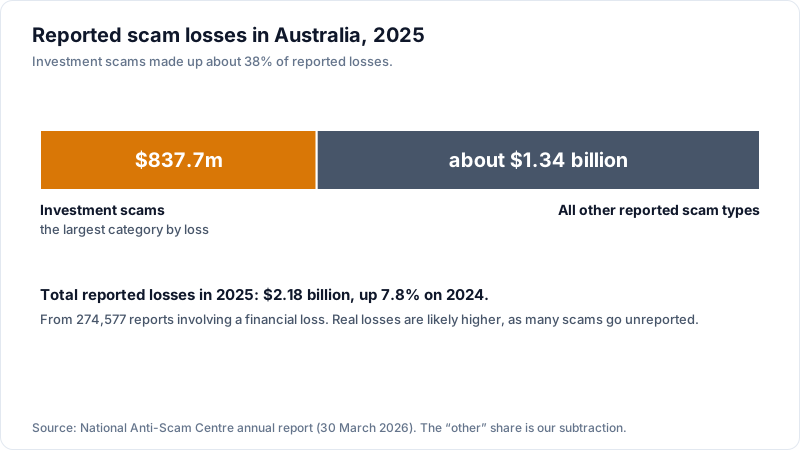
The National Anti-Scam Centre's annual report, published 30 March 2026, recorded $2.18 billion in reported scam losses for 2025, up 7.8% on 2024, from 274,577 reports involving a financial loss. Investment scams were the largest category by loss, at $837.7 million (National Anti-Scam Centre). These are reported losses, so the true figure is likely higher.
Warning Signs
Moneysmart and Scamwatch both list warning signs for investment scams. A single sign doesn't prove a scam, but each one is a reason to slow down and check:
| Warning sign | Why it matters |
|---|---|
| Promises of big returns with little or no risk, or guaranteed returns | Moneysmart says that if an offer sounds too good to be true, you should stop and step back |
| Pressure to act quickly, or constant calls, texts and emails | Pressure leaves no time to check |
| No Australian financial services (AFS) licence, or a claim that one isn't needed | Licensing is one of the few things you can verify publicly |
| Testimonials, celebrity endorsements or social media posts used as proof | Scamwatch notes fake news stories and ads claiming celebrity endorsement |
| An online friend or romantic interest you've never met raises investing | Scamwatch lists this as a warning sign |
| Being asked to recruit friends and family for commission | Scamwatch lists this as a warning sign |
| Use of a reputable organisation's name to look credible | Moneysmart lists this as a warning sign |
On payment, Scamwatch says scammers favour cryptocurrency because it is hard to trace, and that they exploit crypto ATMs. Money lost this way is unlikely to be recovered (Scamwatch).
The Checks, in Order
Moneysmart's "Check before you invest" page sets out a sequence. In summary:
- Check the licence. Search ASIC's Professional Registers by name, ABN, ACN or licence number. Choose the "Australian financial services licensee" or "authorised representatives" register. Confirm the name and number match the business being promoted, and that any website listed matches the one you were given.
- Check for bans. The "Banned and Disqualified" search on ASIC Connect shows whether someone is barred from giving financial advice or managing a company.
- Check the warning lists. Search Moneysmart's Investor Alert List and read ASIC's scams hub. The list covers suspicious companies, businesses and websites that may be unlicensed or impersonating a real licensee.
- Use contact details you find yourself. Don't rely on links, phone numbers or emails supplied in the offer.
- Check the adviser. For a financial adviser, use the Financial Advisers Register on Moneysmart, which shows what they are authorised to advise on.
- Read the documents. Get the product disclosure statement or prospectus from the company's public website or ASIC's Offer Notice Board, and be able to explain how the investment makes money.
(Moneysmart, Moneysmart: Check ASIC lists)
What a Licence Does and Doesn't Tell You
A licence is a useful starting point, not a guarantee. Moneysmart notes that holding an AFS licence doesn't mean ASIC endorses the company or product, or that the investment is safe. The same applies to registration: a registered managed investment scheme isn't an ASIC-endorsed one.
Some investments sit outside the licensing system altogether. Moneysmart warns about unregulated investments, including crypto or digital assets that aren't financial products, direct real estate or precious metals investments, and international investments not offered by licensed Australian providers. You may not be protected if things go wrong. The next articles in this hub look at two of these areas.
If You Think You've Been Scammed
Scamwatch's guidance is to:
- Contact your bank or card provider immediately, ask them to stop transactions, and change passwords on your devices and accounts.
- Get free support from IDCARE (1800 595 160).
- Report the scam to Scamwatch. For cryptocurrency scams, also report to police through ReportCyber.
- Cut contact with the company, and be wary of anyone offering to recover your money, because they are usually scammers too.
Next Steps
Before you invest in anything someone introduced to you, run the checks above and keep a record of what you found. The tool below links to the official lookups and gives a quick self-check. It cannot confirm an offer is safe, because only the official registers and your own reading of the documents can do that. The next article looks at digital assets such as cryptocurrency, which often fall outside the licensing system.
🔍 Verification and Warning-Sign Check
Step 1: Warning-Sign Checklist
Check any of these that apply to the opportunity or the person pitching it to you:
Self-check result: No red flags selected
No warning signs ticked does not mean the offer is safe. Still check the licence and warning lists in Step 2.
Step 2: Official Public Verification
To check a specific company or person, use the official registers below. This tool cannot confirm an offer is safe.