The Ancient Hedge (Gold & Silver)
By Dr KH Asadul · Last reviewed 11 October 2026 · General information only, not personal advice
What gold can and can't do in a portfolio, what it costs, how it is taxed, and how to size a position without borrowing.
Every few years, a corner of the internet becomes convinced that the financial system is about to collapse and that gold and silver are the only safe place to be. The cycle is old and it keeps finding new audiences. Gold can have a place in a portfolio, but the case for it is more modest than the pitch. This article sets out what it is, what it costs, how it is taxed and how big a holding might be, using official and published sources.
What Gold Is, and What It Isn't
Gold pays no dividends and no interest. Any return comes from the price rising, and the price can move a long way in either direction. That is a different profile from shares, property or a savings account, and it is why gold is usually discussed as a diversifier and not as a source of income.
Central banks do hold it. The Reserve Bank of Australia held 2.664 million fine troy ounces of gold, valued at A$9.94 billion, as at 31 January 2025. Nearly all of it (2.662 million ounces) was held at the Bank of England, with four bars at a Sydney holding point. The RBA's July 2025 verification audit examined a sample of 460 of the 6,372 bars at the Bank of England (7.22%) and found no discrepancies (RBA). For scale, that is roughly 83 tonnes, by our own conversion.
Central banks overall bought 863.3 tonnes in 2025, down 21% from 1,092.4 tonnes in 2024. The World Gold Council reports that total gold demand passed 5,000 tonnes (5,002.3 tonnes), that the average price rose 44% to US$3,431.5 an ounce, and that the price set 53 new all-time highs during the year (World Gold Council).
Treat 2025 as an illustration of how volatile the price can be, not as a forecast. A strong year does not tell you what the next year will bring, and buying after a large rise means paying the higher price.
Physical vs Gold ETFs
| Physical bullion | Gold ETF | |
|---|---|---|
| What you own | The metal itself | Units in a fund |
| Costs to check | Dealer buy and sell spread, storage, insurance | Management fee, brokerage when you trade |
| Main risks | Theft or loss, buying something that isn't what it claims, a poor price when you sell | Fund structure and issuer, price falls |
| Convenience | You must sell through a dealer | Trades on the exchange during market hours |
Moneysmart explains that physically backed ETFs own some or all of the assets directly, while synthetic ETFs use derivatives and carry an additional risk that the counterparty could fail. It also says fees and trading costs affect your return (Moneysmart). Before buying any gold fund, read its product disclosure statement and check whether it is physically backed and what the fees are. Fees change, so check the current figures.
Silver is generally more volatile than gold, and a larger share of its demand comes from industry. If you hold some, treat it as a small extra and not a replacement.
How Gold Is Taxed
Tax depends on what you hold, so check your own case with a registered tax agent. Three points are worth knowing:
- GST. The ATO's GST ruling GSTR 2003/10 treats gold of at least 99.5% fineness, and silver of at least 99.9%, in an investment form as "precious metal". The investment form is a bar, wafer or bullion coin traded at a price set by reference to the spot price, with an accepted mark of fineness. Under the ruling, the first supply after refining, to a dealer, may be GST-free, and other supplies of precious metal are input taxed. Proof and collector (numismatic) coins are not precious metal under the ruling, because their prices depend on finish, rarity and condition (ATO).
- Capital gains tax. The ATO's guide says all assets are subject to the CGT rules unless specifically excluded. It lists "coins or medallions" kept for personal use among the collectables, which have special rules, including a $500 threshold. The page does not address gold bullion. The guide we reviewed is the 2022 edition, so check the current one and how your holding is classified (ATO).
- Records. Keep purchase receipts and dates for any metal you hold, because they set your cost base when you sell.
How Much, and a Worked Example
There is no official figure for how much gold a portfolio should hold, and published rules of thumb vary. The right amount depends on your goals, your timeframe and how you would feel in a falling market, and a licensed financial adviser can help you decide.
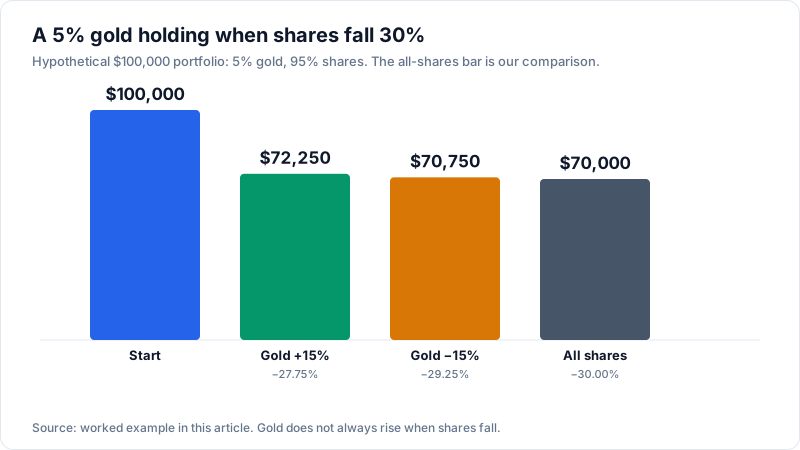
To show what the numbers mean, take a hypothetical $100,000 portfolio with 5% ($5,000) in gold and the rest in shares. In a hypothetical year when shares fall 30%:
| What happens to gold | Share loss | Gold result | Net change | Portfolio value |
|---|---|---|---|---|
| Gold rises 15% | -$28,500 | +$750 | -$27,750 (-27.75%) | $72,250 |
| Gold falls 15% | -$28,500 | -$750 | -$29,250 (-29.25%) | $70,750 |
A 5% holding moves the result by only a little in either direction. Gold does not always rise when shares fall, so this is not protection you can count on. The calculator below lets you change each input.
One rule that matches official guidance: don't borrow to buy it. Moneysmart says borrowing to invest increases what you lose if your investments fall, that you can lose more than you invest, and that you must repay the loan and interest regardless of how the investment goes. With a margin loan, you can face a margin call and generally have 24 hours to bring the loan down, or the lender may sell your investments (Moneysmart).
Next Steps
Decide whether gold fits your goals before you decide how to buy it. If you go ahead, compare dealer spreads or fund fees, keep records and keep the amount small enough that a fall in the price wouldn't change your plans. Money Without Borders looks at holding money and assets across borders.
🛡️ Gold Allocation Scenario Calculator
Test a hypothetical gold or silver allocation against a market fall. The inputs are assumptions you choose, not forecasts.
From a $95000 holding
From a $5000 holding
In this hypothetical scenario, a 30% fall in shares and a 15% move in gold and silver changes your portfolio by 27.8% with a 5% allocation. Gold does not always rise when shares fall, so try a negative figure for gold too. This is general information, not a recommendation or a forecast.