Money Without Borders
By Dr KH Asadul · Last reviewed 11 October 2026 · General information only, not personal advice
For a lot of people in Australia, "my finances" doesn't mean one country. Money moves both ways: some of it goes home to family, some obligations — a parent's care, a property, a family business — stay behind, and none of the standard local budgeting advice quite accounts for either direction.
Two Countries, One Budget
Many people in Australia have financial ties in more than one country. Money may go home to family, and obligations such as a parent's care, a property or a family business may stay behind. Standard budgeting advice rarely covers either. This article is about planning for both: how to fit regular transfers into a budget, how to compare ways of sending money, and what to know about tax when two countries are involved.
Plan the Transfer Like Any Other Bill
Obligations to family are real and ongoing. The practical step is to decide in advance, in writing, what the regular commitment is (an amount and how often) and treat it as a planned line in the budget, like rent or an insurance premium. If it comes from whatever is left over, a difficult month at home can drain savings built for a local emergency.
Keep your emergency fund as a separate goal so that a request from home doesn't automatically come out of the same pool. Moneysmart suggests keeping an emergency fund in a separate account for exactly this reason: you are less tempted to spend it on everyday costs (Moneysmart). If you need to send more than the planned amount, rebuild what you used on purpose, the way you would after any other emergency withdrawal.
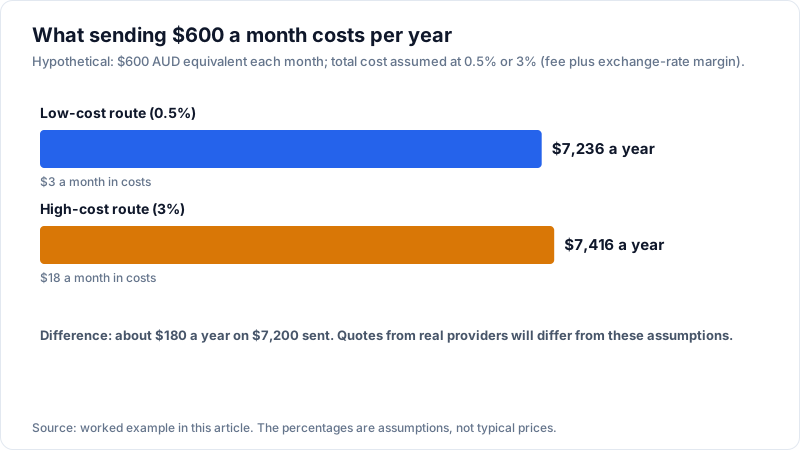
Here is a hypothetical monthly example. Net income is $6,000, living expenses are $4,000, and the family commitment is the equivalent of $600 in Australian dollars before costs. The costs of sending change the result:
| Low-cost route | High-cost route | |
|---|---|---|
| Amount to deliver (AUD equivalent) | $600 | $600 |
| Assumed total cost (fee plus exchange-rate margin) | 0.5% = $3 | 3% = $18 |
| Cost per month | $603 | $618 |
| Cost per year | $7,236 | $7,416 |
| Left over from a $2,000 monthly surplus | $1,397 | $1,382 |
The two routes differ by about $180 a year in this example. The percentages are assumptions to show how the arithmetic works, not typical prices. Use quotes from real providers.
Compare How You Send It
Moneysmart sets out the main points about sending money overseas (Moneysmart):
- Banks and money transfer businesses. Banks use the SWIFT network. Money transfer businesses are often online only and can be faster and cheaper than banks. Money can go to a bank account or be collected at a local branch or agent.
- Check registration. Confirm the business is registered with AUSTRAC before you use it.
- Providers set their own rate. Costs depend on how much you send, where it goes and how you send it. Check whether the advertised rate is the one you will actually get, and whether it is guaranteed or can change.
- Compare every cost. That includes flat or percentage fees, the margin charged to convert your currency, and whether the receiver pays any fees. Also compare transfer times and how the receiver collects the money.
- Shop around. Costs can vary a lot. Moneysmart names independent comparison sites: SaverAsia, for sending from Australia to Asia, and the World Bank's Remittance Prices Worldwide, for other destinations.
Two warnings from the same page. Be careful who you send money to, because once money reaches a scammer it is almost impossible to get back. And if a transfer goes wrong, contact the bank or money transfer business first, then the Australian Financial Complaints Authority if they are a member.
Tax When Two Countries Are Involved
Australian residency. The ATO lists four tests for being an Australian resident for tax purposes: the resides test, the domicile test, the 183-day test and the Commonwealth superannuation test. The ATO's criteria look at where you live and for how long, not at your visa or citizenship (ATO).
Dual residency. You can be a resident of both Australia and another country at the same time. The ATO says that where Australia has a tax treaty with that country, a tie-breaker test generally decides which country can tax the income.
Worldwide income. Australian residents must declare income earned anywhere in the world in their Australian tax return. That includes foreign employment, business and investment income, and capital gains. Foreign income, deductions and offsets must be converted to Australian dollars (ATO).
Double tax relief. If you have paid tax overseas on income you earned there, you may be able to claim a foreign income tax offset. You must have actually paid the foreign tax and hold records. The offset may not equal the amount you paid, and if you are claiming more than $1,000 you need to calculate an offset limit first (ATO).
How these rules apply depends on the two countries involved, the type of income and your circumstances. A registered tax agent with experience in your country pair is a better guide than forum posts.
Obligations That Stay Behind
If you support a parent, own a property or share in a family business overseas, write each one down with a rough annual cost and a date you will review it. These items can create income to declare, foreign tax to report or costs you will need to cover in a bad year. Bring the list to your tax agent so that nothing is left out.
Next Steps
Use the calculator below with your own numbers to see what a regular transfer leaves of your monthly surplus. Then get quotes from two or three registered providers and compare the total cost, not just the fee. If you do not yet have an emergency fund, read our article on building one first, so that a request from home is not paid out of it.
Dollar examples are hypothetical. Exchange rates, provider costs and tax rules change, so check the linked sources before you act.
🌍 Dual-Country Cash Flow Mapper
Estimate what a regular transfer leaves of your monthly surplus. Rates and costs change, so use quotes from real providers.
Local Finances (AUD)
Overseas Remittance
On these inputs your surplus covers the transfer, with a buffer left over. This is an estimate: check it against real quotes and your own budget.