Digital Scarcity (Cryptocurrency)
By Dr KH Asadul · Last reviewed 23 October 2026 · General information only, not personal advice
What Moneysmart and ASIC say about crypto risks, the April 2027 digital assets licensing law, how the ATO taxes crypto disposals, and the CGT discount change from 1 July 2027.
Digital Scarcity (Cryptocurrency)
Cryptocurrency attracts strong opinions in both directions. This article does not argue for or against it. It sets out what Moneysmart and ASIC say about the risks, what changes in Australian regulation from April 2027, how the ATO treats crypto for capital gains tax (CGT), and why the CGT discount change from 1 July 2027 matters for anyone who holds it. It is general information as at 23 October 2026, not personal advice.
What Crypto-Assets Are, and the Risks
Moneysmart describes crypto-assets as digital assets, including coins, tokens and cryptocurrencies, that rely on cryptography and technology such as blockchain. They are not legal tender in Australia, and few people use them for everyday purchases. Moneysmart says plainly that "it's not the sort of investment to use to build your savings" (Moneysmart).
The risks it lists include:
- Price volatility. Values can swing sharply in short periods, driven by hype and sentiment. Moneysmart says to be prepared to lose everything you put in.
- Unlicensed providers. Many providers are not licensed, so you may have little protection if a platform fails or is hacked. There is currently no public register to check whether an exchange is legitimate.
- Theft and lost keys. Wallets hold private keys, and losing a key usually means losing the crypto. Hackers can steal from wallets, and recovery is unlikely. Offline hardware wallets may offer more protection.
- No disclosure document. There is usually no product disclosure statement or prospectus, and users can make costly errors such as sending funds to the wrong address.
- Scams. Moneysmart says crypto scams are common because transactions are hard to reverse and funds move overseas quickly. Warning signs include unsolicited contact, pressure to deposit more, and promises of high returns.
If you consider holding any, Moneysmart's advice is to treat it as a high-risk, speculative investment and only invest money you can afford to lose. That means money that is not needed for an emergency fund, a home deposit or any goal with a deadline.
Regulation: What Changes in April 2027
The Corporations Amendment (Digital Assets Framework) Act 2026 passed Parliament on 1 April 2026 and received Royal Assent on 8 April 2026. It brings digital asset platforms and tokenised custody platforms into the financial services licensing regime, with ASIC licensing and supervising them. The ASIC roadmap says commencement is in April 2027 after an 18-month implementation period, and that ASIC will issue guidance and standards on topics such as separating client assets from the operator's own (ASIC). Moneysmart and ASIC state slightly different start dates (8 and 9 April 2027), so check the current date.
Until then, Moneysmart says protections are limited to the extent crypto fits within existing law. The new framework covers platforms, not the price risk of the assets themselves.
How the ATO Treats Crypto
The ATO treats each crypto asset as a separate CGT asset. Its transactions page lists the following as disposals that trigger a CGT event: selling, gifting, swapping one crypto asset for another, converting crypto to Australian or foreign currency, and spending crypto on goods or services. Values are converted to Australian dollars using Reserve Bank exchange rates (ATO). The ATO's landing page also points to rules for personal use assets, chain splits and decentralised finance, which are beyond this article.
The ATO says to keep records of purchases, transfers and disposals, the date and purpose of each transaction, the other party's wallet address, exchange records, and the Australian dollar value at the time of each transaction. Keep them for 5 years from the latest of when the records were prepared, when the transactions were completed, or the year the CGT event happened (ATO). A 2021 ATO release says it matches data from crypto exchanges to tax returns, but that page is dated (ATO).
The CGT Discount Change From 1 July 2027
Under the classic rules, an individual who holds a CGT asset for more than 12 months receives a 50% discount, so only half the gain is added to taxable income. As a hypothetical, a $10,000 gain held for more than 12 months adds $5,000 to taxable income, which at a 39% marginal rate including Medicare levy is about $1,950 in tax before other items.
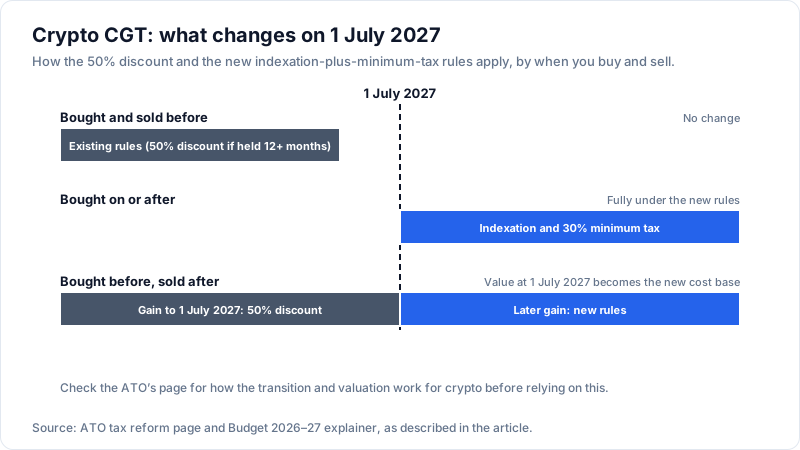
The ATO says the Government's CGT measures announced in the 2026–27 Budget on 12 May 2026 are now law and apply from 1 July 2027. For CGT, the 50% discount for individuals, trusts and partnerships is replaced by cost base indexation and a 30% minimum tax rate on gains (ATO). The same ATO page sets out the transition:
| Situation | Treatment |
|---|---|
| Bought and sold before 1 July 2027 | No change |
| Bought on or after 1 July 2027 | Fully under the new rules |
| Bought before 1 July 2027, sold after | Gains up to 1 July 2027 keep the 50% discount; the value at 1 July 2027 becomes the new cost base |
Crypto assets are CGT assets, so the general rules should apply, but check the ATO page for how the transition and valuation work for crypto before you rely on it.
Storage and Sizing
Moneysmart notes that coins are held in hot (online) or cold (hardware) wallets. A custodial exchange means relying on a third party, and self-custody puts responsibility for keys and security on you. This article does not give a suggested percentage of a portfolio, because the right size depends on your circumstances. Moneysmart's guide is to consider a financial adviser for a diversified portfolio.
A Warning for Super and SMSFs
ASIC has described crypto-assets as a high-risk and speculative investment and warned that scammers target SMSF trustees with pitches to invest in crypto through an SMSF. It says any investment must be allowed under the trust deed and fit the fund's documented investment strategy, and recommends licensed advice before moving super into an SMSF (ASIC, 2022).
Checklist
- Decide in advance how much you could lose without affecting your goals.
- Check whether an exchange or product is a licensed financial service; there is no public register for crypto exchanges.
- Be wary of unsolicited contact, pressure to deposit more and promises of high returns.
- Record the date, AUD value, purpose and wallet details of every transaction, and keep them for 5 years.
- Remember that swaps, spending and gifts are disposals, not only sales.
- Check the 1 July 2027 CGT transition before selling, and consider a registered tax agent.
Next Steps
Use the calculator below to estimate a capital gain under the 50% discount rules or a simplified version of the 2027 rules. It is an estimate only and leaves out several items. Then read The Ancient Hedge (Gold and Silver) to see how a physical asset is treated differently.
🪙 Crypto CGT Estimator
A simplified estimate of capital gains tax on one crypto asset under the old and the 1 July 2027 rules.
Assets bought before 1 July 2027 and sold after it follow the ATO's transition rules, which this estimator does not model.
Half the gain is added to your taxable income (the 50% discount for individuals).
Not modelled: other income and capital losses, the transition rules for assets bought before 1 July 2027, fees, personal use asset exemptions, and swaps or other disposals during the holding period. Each crypto asset is a separate CGT asset. General information only, not tax advice; check the ATO and consider a registered tax agent.
Sources and further reading
- Moneysmart: Crypto assets
- ATO: Crypto asset transactions
- ATO: Keeping crypto records
- ATO: Tax reform (negative gearing and capital gains tax)
- ASIC: Roadmap for digital assets law reform implementation
- ASIC: Warning on self-managed super funds and crypto investments (2022)
- ATO: Cryptocurrency under the microscope this tax time (2021, dated)