Self-Managed Super Funds (SMSF) Overview
By Dr KH Asadul · Last reviewed 23 October 2026 · General information only, not personal advice
An SMSF gives you control over investments but makes you the trustee. This guide covers trustee duties, the protections you give up, how fixed costs behave at different balances, and the 10 August 2026 change to SMSF property borrowing.
Self-Managed Super Funds (SMSF) Overview
A self-managed super fund (SMSF) is a private super fund that you run yourself. Moneysmart describes it as a fund where you choose the investments and insurance, with no more than six members, and where the members are the trustees (or use a corporate trustee). That control comes with legal responsibility, running costs and the loss of some protections. This article sets out what an SMSF involves, how fixed costs behave at different balances, and what changed for SMSF property borrowing on 10 August 2026. It is general information as at 23 October 2026, not personal advice.
What Running an SMSF Involves
The ATO lists the trustee's responsibilities as arranging an annual audit, keeping proper records, reporting on the fund's operations, and making sure the fund meets tax and super laws when it is set up, invests, takes contributions and pays benefits (ATO).
Moneysmart adds that members remain personally liable for the fund's decisions and compliance even if they use professionals or another member made the decision. It also says trustees spend on average more than eight hours a month, or over 100 hours a year, on research, record-keeping, reviewing the investment strategy and the annual audit by an approved SMSF auditor (Moneysmart).
What You Give Up
Moneysmart lists several protections that do not apply to an SMSF:
- You have no access to government compensation if you lose money through theft or fraud.
- The Australian Financial Complaints Authority (AFCA) cannot take complaints against an SMSF, although you can complain about third-party firms that advised you.
- You could lose insurance when moving from an industry or retail fund.
- Relationship breakdown, or a member's death or illness, can affect the fund.
The Rules on Investing
Every SMSF investment must be made and maintained to provide retirement benefits to members, or death benefits if a member dies before retiring. This is the sole purpose test. The ATO says a breach can occur if you or a related party gain more than an incidental personal benefit, with examples including using an investment property for holidays or keeping collectables such as art or wine in a private residence. A breach can lead to loss of tax concessions and penalties or other compliance action.
The ATO also says super law requires a written investment strategy, that investments must be on a commercial arm's length basis at true market value, and that the fund must have clear legal ownership of its assets (ATO). Further restrictions on related-party dealings apply, so read the ATO's restrictions pages before acquiring an asset.
Borrowing and Property: What Changed on 10 August 2026
An SMSF is generally prohibited from borrowing, with limited exceptions. One exception is a limited recourse borrowing arrangement (LRBA), where the fund borrows to buy a single asset (or a set of identical assets) held in a separate trust, protecting the fund's other assets if the loan defaults (ATO).
From 10 August 2026, an LRBA can only be used to acquire real property if the property is business real property. The change applies to LRBAs entered into on or after that date. The ATO says existing LRBAs, refinancing of those LRBAs, and binding contracts to acquire real property exchanged before 10 August 2026 are unaffected (ATO newsroom). The ATO page does not define business real property in the text, so check its definitions page and take advice before relying on a particular property qualifying.
How Fixed Costs Behave at Different Balances
Moneysmart says set-up and running costs can be high and include investing, accounting, auditing, tax, legal, financial advice and insurance costs, and that overall suitability matters more than the starting balance. This article does not quote a typical annual cost, because the figures available to us were not current or independently sourced. Get written quotes before deciding.
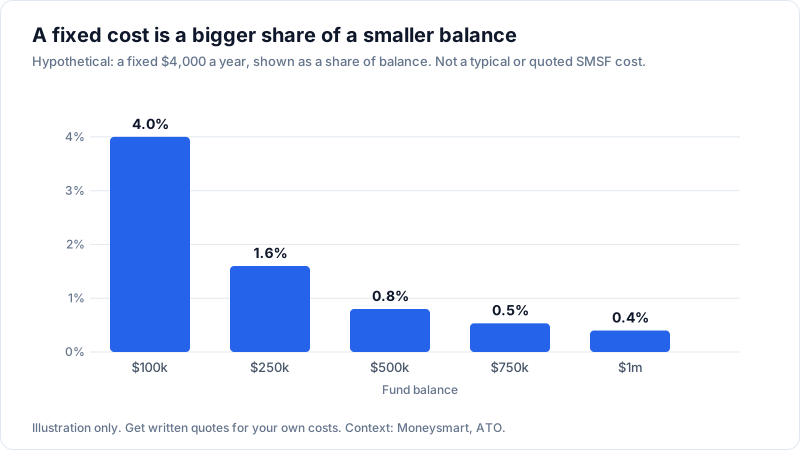
The table below is a hypothetical illustration only. It assumes a fixed cost of $4,000 a year and shows the cost as a share of balance:
| Balance | Fixed cost as share of balance |
|---|---|
| $100,000 | 4.0% |
| $500,000 | 0.8% |
| $1,000,000 | 0.4% |
The point is arithmetic rather than a verdict: a fixed dollar cost is a larger percentage of a smaller balance, whereas many public funds charge a percentage. A cost comparison also leaves out time, protections and investment choices.
For context, ASIC's 2019 media release cited a Productivity Commission finding that SMSFs with balances under $500,000 had lower average returns, after expenses and tax, than industry and retail funds (ASIC). That release is dated and ASIC has marked its related factsheet as expired, so treat it as background only. The ATO's June 2026 statistics show 680,301 SMSFs and average assets of $1.7 million per fund for 2024–25, which means the typical fund is far larger than the balances in the table (ATO).
Questions to Settle Before Starting
- Do you have the time, skills and records discipline for the trustee role, and a plan if a co-trustee dies or becomes ill?
- Have you obtained written quotes covering set-up, accounting, audit and tax?
- What would you hold in the fund that you cannot hold in your current fund, and does it satisfy the sole purpose test?
- If property is the goal, is it business real property, and how will the fund stay liquid?
- Have you compared insurance cover you would lose?
- Have you spoken to a licensed financial adviser with SMSF expertise? Moneysmart says advice should cover suitability, costs, benefits you may lose, compliance duties and penalties, and the time and skills required. It also warns against high-pressure sales and anyone offering to withdraw your super to pay off debts.
Next Steps
Use the calculator below for a cost-only comparison at your own balance, using quotes in place of the placeholder figures. Then read the ATO's pages on SMSF obligations before deciding.
🏛️ SMSF Viability Checker
A cost-only comparison of a fixed SMSF cost against a percentage-based fund. Replace the placeholder figures with real quotes.
Placeholder only: use written quotes
Annual percentage fee
Fixed costs are a large share of this balance
On these inputs the fixed dollar cost is a high percentage of your balance, so the SMSF would need to deliver clear benefits to justify it. The Productivity Commission finding cited by ASIC in 2019 was that SMSFs under $500,000 had lower average returns than industry and retail funds, after expenses and tax.
Not included: trustee time (Moneysmart says over 100 hours a year on average), personal liability, loss of government compensation and AFCA access, insurance differences, and investment returns. This is general information, not personal advice.
Sources and further reading
- Moneysmart: Self-managed super funds (SMSF)
- ATO: Self-managed super funds
- ATO: SMSF investment requirements
- ATO: SMSF borrowing restrictions
- ATO: Changes to LRBAs for property from 10 August
- ATO: SMSF quarterly statistical report, June 2026
- ASIC: ASIC urges consumers to question whether SMSFs are right for them (2019, dated)