Consolidating Lost Super & Finding Missing Accounts
By Dr KH Asadul · Last reviewed 11 October 2026 · General information only, not personal advice
Every time you move houses, change your name, or start a new job, you risk losing track of your Super.
Consolidating Lost Super & Finding Missing Accounts
Every time you move house, change your name or start a new job, you risk losing track of your super. Many people end up with several accounts, each charging fees, and some money ends up with the ATO because a fund could not reach its owner. This guide explains how to find your super and combine it, and what to check first. It is general information and not personal advice.
Lost Super and ATO-Held Super
The ATO explains that super is classed as lost in two situations (ATO):
- The fund cannot contact you, and the account has received no contribution or rollover for 12 months. This often follows a change of name, address or job.
- The account is inactive, with no contribution or rollover for five years.
Lost super stays with your fund while it tries to reach you. If it cannot, the account may be transferred to the ATO as unclaimed super. The ATO holds this money until it is paid to you or moved to another super account you have, and it shows as "ATO-held super" in your online account.
How Big Is the Problem?
As at 30 June 2026 the ATO reports just over $21.2 billion in lost and ATO-held super across about 7.5 million accounts: $14.7 billion of lost super held by funds (356,000 accounts) and $6.6 billion held by the ATO (about 7.13 million accounts) (ATO).
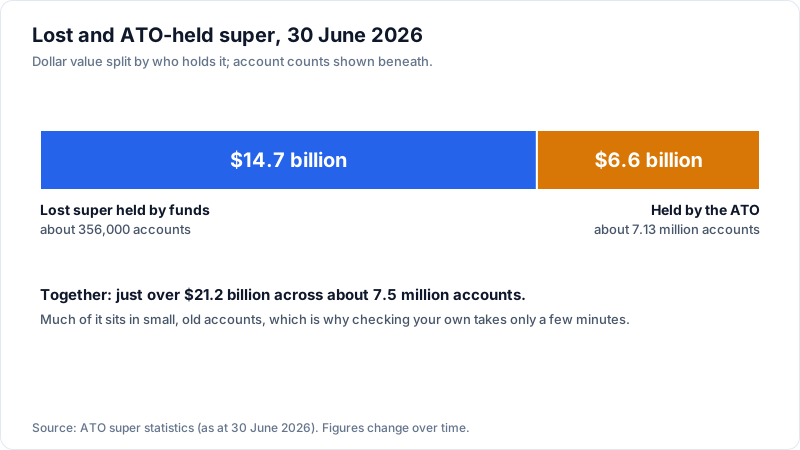
Note: these figures are as at 30 June 2026 and change over time. Please check the ATO's super statistics for the latest numbers.
The Silent Wealth Killer: Duplicate Fees
Why does it matter if $30,000 of super is in one account or split across three? Because most funds charge both a percentage-based investment fee and administration fees, and many accounts also carry insurance premiums. The ATO notes that multiple accounts can drain your savings through account fees and duplicated insurance costs, so consolidating may reduce costs (ATO).
Here is a hypothetical example, not a quote from any fund. Suppose duplicate accounts cost you an extra $400 a year in fees and premiums. If that $400 had instead stayed in your balance and earned an assumed 5% a year for 40 years, it would have grown to about $48,000. The real figure depends on your funds, your insurance and your investment returns, but it shows why small, repeated costs matter.
Stapling: Preventing New Duplicates
To stop people opening a new account every time they change jobs, the government introduced super stapling. If you do not choose a fund when you start a job, your employer checks with the ATO for your existing fund and pays into that one. If you have no fund, your employer pays into a default product it chose (Moneysmart). Your stapled fund may not be the best one for you, so it is still worth comparing.
How to Find Your Super
You can search for free, and you do not need to pay a third party. The ATO lists these options:
- ATO online services through myGov, or the ATO app: select Super, then Fund details.
- The lost super search line: call 13 28 65 with your tax file number, personal details and fund details ready.
- The superannuation enquiries line: 13 10 20, if you cannot use the self-service line.
- Paper form NAT 2476, posted to the ATO.
- Your fund or an authorised tax agent, who can check for you.
In your online account, a lost account shows "Contact fund" next to the fund name, so contact that fund directly. Check the "as at" date on each balance: balances are usually 30 June figures reported by your funds, so they may not be current. Your fund's latest member statement may show a more recent balance.
A Four-Step Super Health Check
- Count your accounts in ATO online services.
- Compare fees and value, because combining accounts may lower fees and make them easier to manage (ATO).
- Check each account's insurance cover and whether the fund you plan to keep offers cover that still suits you.
- Consolidate: in ATO online services, go to Super, then Manage, then Transfer super. Then confirm with your funds that the transfer has been processed.
You can choose which accounts or balances to transfer, and you do not have to move everything at once.
Check Your Insurance First
Before you consolidate and close an old account, check what insurance is attached to it. Moneysmart warns that you may lose life, total and permanent disability (TPD) or income protection cover when you switch, and that you should check your new fund offers similar cover first (Moneysmart). If your health has changed since you took out the old cover, you may not be able to get equivalent cover today. Confirm with both funds before closing anything.
Watch for Scams and Pressure Sales
Moneysmart warns about unsolicited phone calls, click bait ads and promises of unrealistic returns, and advises you to stop, think and check claims first (Moneysmart). Be careful about anyone who contacts you offering to "find" or move your super, especially if they ask for your myGov details or tax file number. The ATO search is free.
Interactive: The Cost of Duplicate Accounts
Are you ignoring an old super account? Use the calculator below to see how duplicate flat fees and insurance premiums can erode your balance over time.
✂️ The Cost of Duplicate Accounts
See how much wealth you are destroying by paying multiple flat fees.
(E.g., if you have 3 accounts, 2 of them are duplicates).
Annual flat fee
Annual life/TPD premiums
If you consolidated your accounts today and left that $856 invested every year at 8% instead of paying it in duplicate fees:
⚠️CRITICAL: Check the insurance policies on your old accounts before you consolidate. If you have pre-existing medical conditions, you may not get coverage in a new fund.