Choosing a Super Fund: Industry vs. Retail
By Dr KH Asadul · Last reviewed 11 October 2026 · General information only, not personal advice
Every Australian employee has the right to choose their own super fund. If you don't make a choice when you start a new job, the government will try to "staple" you to your existing fund, or place you in your employer's default fund.
Choosing a Super Fund: Industry vs. Retail
Every Australian employee has the right to choose their own super fund. If you do not choose when you start a new job, your employer checks with the ATO for an existing fund of yours, which is called your stapled fund. If you have no fund, your employer pays into a default product it chose (Moneysmart). Neither is necessarily the right fund for you, so it pays to compare. This guide is general information and not personal advice.
Types of Super Funds
Moneysmart sets out the main types (Moneysmart):
| Fund type | Who can join | Where profits go | Notes |
|---|---|---|---|
| Industry | Mostly open to anyone | Returned to members | Fees low to medium |
| Retail | Open to anyone | Partly returned to members; some goes to the company and its shareholders | Fees range from low to high; some need a financial adviser |
| Public sector | Certain government workers | Returned to members | Often lower fees, as your employer pays some |
| Corporate | Employees of the company (some are open to all) | Usually returned to members | Fees depend on fund size |
| SMSF | You and up to five other members, all trustees | Not stated | You control investments; higher costs, admin and risk |
Industry funds were originally created by unions and employer groups, and most are now open to the public. They are run to return profits to members. Retail funds are typically run by banks and financial companies, and some of the profit goes to the company and its shareholders. That difference in structure does not by itself tell you which fund will perform better, so compare the specific product you are considering.
How to Compare Funds
Moneysmart suggests comparing these five things (Moneysmart):
- Investment options: growth, balanced, conservative, cash and others. Choose one that matches your risk tolerance and time to retirement. If you make no choice, your money goes into the fund's MySuper product.
- Performance: compare the same option across funds over five years or longer. Past performance is not a guarantee of future returns.
- Fees and costs: administration, investment, buy/sell spread, transaction, switching and personal advice fees.
- Insurance: funds typically offer life, total and permanent disability (TPD) and income protection cover. Compare premiums, cover amounts, exclusions and waiting periods.
- Services: online tools, advice, customer service and how easily you can make changes.
Always compare the same kind of option. Do not compare the high growth option of one fund with the conservative option of another.
Why Fees Matter: An Example
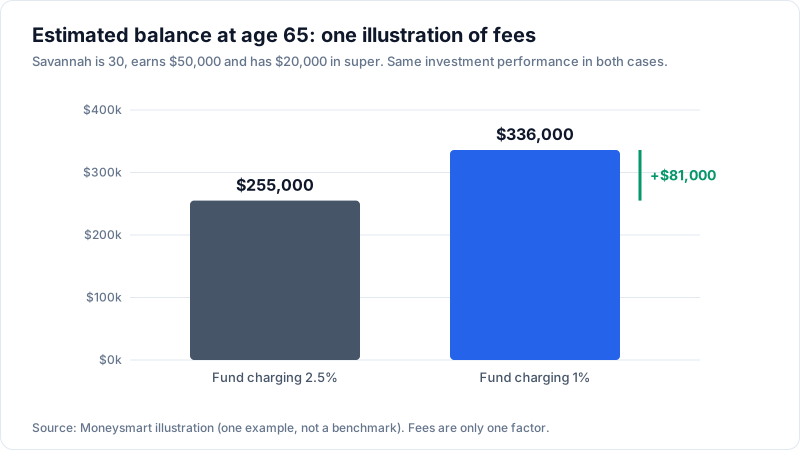
Moneysmart gives this illustration: Savannah is 30, earns $50,000 and has $20,000 in super. If she switches from a fund charging 2.5% to one charging 1% for the same performance, she could have an estimated $336,000 instead of $255,000 at age 65, about $81,000 more. It is one illustrative example and not a benchmark, and fees are only one factor. Lower fees usually help your balance grow faster for the same performance, but a cheaper fund with poorer returns or weaker insurance may not suit you.
The YourSuper Comparison Tool
The ATO's YourSuper comparison tool lets you compare MySuper products on performance and fees. It shows each product's performance rating (performing, underperforming or not assessed), 3-, 5- and 10-year net returns, total annual fee and investment strategy. You can compare up to four products at once. Only MySuper products are included, and a product with fewer than seven years of history is "not assessed". A product rated underperforming for two consecutive years cannot accept new members until it is rated performing again, though existing members can stay (ATO). You can reach the personalised version through myGov, and a general version from the ATO page. The ATO notes that it is not a financial adviser.
The Annual Performance Test
APRA tests super products each year. On 28 August 2026 it reported that it had tested 547 products, representing 61% of APRA-regulated member benefits, and 12 failed: 1 of 50 MySuper products and 11 of 141 platform trustee-directed products. APRA said the failures were largely driven by poorer investment performance, not higher administration fees and costs (APRA). Moneysmart adds that if your fund underperforms the test, it must tell you.
Note: these results are correct as at 11 October 2026. APRA publishes new results each year, so check the latest before you decide.
Before You Switch
Moneysmart lists the things to check before moving your super (Moneysmart):
- Insurance: you may lose life, TPD or income protection cover attached to your current account. Check that your new fund offers similar cover before you close the old one.
- Fees: compare what you pay with what you get.
- Exit fees: the Moneysmart page does not mention them, so ask your current fund about any costs for leaving.
- Employer contributions: confirm your employer can pay into the new fund and give them your new details.
- Multiple accounts: extra accounts can add fees and insurance costs, but check what you would lose before combining them. Our guide to lost super covers how to find and consolidate accounts.
You do not have to move everything at once.
Watch for Pressure Sales
Moneysmart warns about high-pressure sales tactics, including unsolicited phone calls, click bait ads and promises of unrealistic returns, and advises you to stop, think and check claims first. It also says not to rely only on comparison website ratings, because sites use different criteria.
Should You Consider an SMSF?
A self-managed super fund makes you a trustee with full legal responsibility for investments and compliance, and Moneysmart notes there is no access to AFCA complaints or government compensation for fund-level losses. It suits people with time, knowledge and the funds to cover running costs that may exceed those of retail or industry funds (Moneysmart). See our SMSF guide before you consider it.
The takeaway: the brand matters less than the specific option and its fees, performance and insurance. If you are unsure, consider speaking to a licensed financial adviser.
Interactive: The Super Fee Drag Calculator
Even a small difference in fees compounds over decades. Use the tool below to compare a lower fee against a higher fee on your own balance and see the impact over time.
⚓ The Super Fee Drag Calculator
A 1% fee difference sounds harmless, until you see what it does to compounding over 40 years.
* Assuming 8% gross investment returns and the 12% Super Guarantee (minus standard 15% contribution tax).
This isn't just money you paid directly in fees. It represents the compound growth you permanently lost because those fee dollars were removed from your account instead of staying invested.