Concessional vs. Non-Concessional Contributions
By Dr KH Asadul · Last reviewed 23 October 2026 · General information only, not personal advice
Employer super is the minimum. This guide explains the before-tax and after-tax contribution types, the 2026–27 caps, what happens if you exceed them, and the tax effect at different marginal rates.
Concessional vs. Non-Concessional Contributions
Beyond the employer contributions that come with a job, you can add your own money to super. The tax treatment depends on whether the money goes in before or after income tax, and the Australian Taxation Office (ATO) caps how much can go in each year. This article explains the two types, the 2026–27 caps, what happens if you exceed them, and when adding extra is worth checking with a professional. It is general information as at 23 October 2026, not personal advice.
Concessional Contributions (Before-Tax)
Concessional contributions are generally taxed at 15% when they reach your fund, instead of at your marginal rate. The ATO says they include employer super guarantee and salary sacrifice contributions, personal contributions you claim as a tax deduction, and costs your employer pays on your behalf such as administration fees and insurance premiums. All of them are added together across every fund you hold and measured against one cap (ATO).
Two common routes are:
- Salary sacrifice. You ask your employer to pay part of your pre-tax pay into super. Moneysmart describes these as concessional contributions taxed at 15% (Moneysmart).
- Personal contribution with a deduction. You pay from your own bank account and then claim a tax deduction. Moneysmart notes you must lodge the ATO's notice of intent with your fund before you claim, and that claiming changes how the contribution is treated.
The Caps for 2026–27
| Income year | Concessional cap | Non-concessional cap |
|---|---|---|
| 2025–26 | $30,000 | $120,000 |
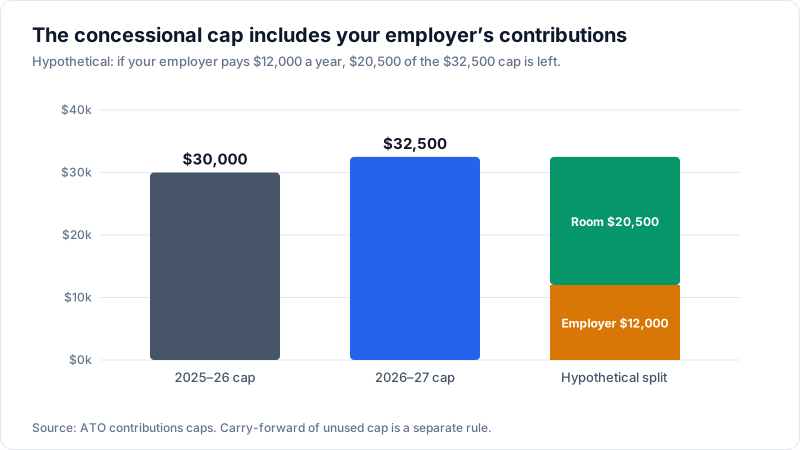
| 2026–27 | $32,500 | $130,000 |
Source: ATO contributions caps. The ATO says the $32,500 cap applies from 1 July 2026 after indexation to average weekly ordinary time earnings, and the non-concessional cap is a multiple of the concessional cap.
The concessional cap includes what your employer already pays. As a hypothetical, if your employer pays $12,000 of super guarantee in a year, the remaining room is $32,500 − $12,000 = $20,500 for salary sacrifice or deductible personal contributions.
Carrying Forward Unused Cap
The ATO says you can use unused concessional cap from up to five previous years if your total super balance was under $500,000 on 30 June of the previous financial year. The oldest unused amounts are used first, and unused amounts expire after five years. The ATO's example shows someone with $67,500 of unused cap able to contribute $97,500 in one year. Your unused amounts are shown in ATO online services through myGov.
If You Go Over the Concessional Cap
Excess concessional contributions are included in your assessable income and taxed at your marginal rate, less a 15% tax offset for the contributions tax your fund already paid. The separate excess charge applied to 2013–14 to 2020–21 and no longer applies from 1 July 2021. You can ask to release up to 85% of the excess from your fund to help pay the tax, and you have 60 days to elect. Any excess not released counts toward your non-concessional cap (ATO).
Division 293 Tax
For people with higher incomes, the ATO applies an extra 15% on concessional contributions. The threshold is $250,000, and the ATO says your income is added to certain super contributions, with the tax applying to the lesser of the excess over the threshold or your contributions (ATO). The ATO page does not define which income counts, so check its linked Division 293 page if you are near the threshold.
Non-Concessional Contributions (After-Tax)
These come from money you have already paid income tax on, so no further contributions tax applies when they enter the fund. They are not tax-deductible. The cap is $130,000 for 2026–27 and is reduced or removed as your total super balance rises.
The Bring-Forward Rule
If you are under 75 at any time in the financial year, you may bring forward two or three years of caps, depending on your total super balance on 30 June of the previous year. The ATO's table for 2026–27 onward is:
| Total super balance | First-year cap | Bring-forward period |
|---|---|---|
| Less than $1.84 million | $390,000 | 3 years |
| $1.84 million to under $1.97 million | $260,000 | 2 years |
| $1.97 million to under $2.1 million | $130,000 | None |
| $2.1 million or more | Nil | Not applicable |
Source: ATO non-concessional contributions cap. Once triggered, the cap stays at the first-year amount, and later years' caps are the bring-forward total minus what you contributed in the first year.
If You Exceed the Non-Concessional Cap
The ATO gives you 60 days from its determination to choose between two options. Option 1 releases the excess plus 85% of associated earnings, with the earnings added to your taxable income and a 15% non-refundable offset. Option 2 leaves the excess in the fund, where it is taxed at the highest marginal rate plus Medicare levy, which the ATO says is currently 47%. If you make no election, Option 1 applies.
A Hypothetical Comparison
Suppose you have $10,000 of pre-tax pay and are comparing taking it as wages or putting it into super as a concessional contribution. The numbers below ignore fees, investment returns and any later tax on withdrawals.
| Your marginal rate (including Medicare levy) | Left after tax as wages | Left after 15% contributions tax | Difference |
|---|---|---|---|
| 17% (income $18,201–$45,000) | $8,300 | $8,500 | $200 |
| 32% (income $45,001–$135,000) | $6,800 | $8,500 | $1,700 |
| 47% (income above $190,000) | $5,300 | $8,500 | $3,200 |
Rates are from the ATO resident tax rates for 2026–27 plus the 2% Medicare levy. The extra money in super is not equivalent to cash in the bank: it is generally preserved until you meet a condition of release, fees and investment choices affect the outcome, and Division 293 can add 15% at higher incomes. At low marginal rates the advantage is small.
Practical Checklist
- Check your year-to-date employer contributions on your payslip or fund statement before adding more.
- Find your unused concessional cap and total super balance in ATO online services via myGov.
- If you plan a personal deduction, lodge the notice of intent with your fund and wait for acknowledgment before you claim.
- Remember that contributions can be counted in the year your fund receives them, so allow time at the end of June.
- If you are on a low income, Moneysmart notes the low income super tax offset of up to $500 a year may apply without an application, and a government co-contribution may be available for eligible after-tax contributions.
- Consider the access rules before locking money away. A licensed financial adviser or tax professional can look at your whole situation.
Next Steps
Use the calculator below to compare a pre-tax contribution with taking the money as wages at your own marginal rate. Then read the article on how super works for the access rules, and confirm current caps on the ATO site before acting.
🛡️ The Contribution Tax Optimizer
An estimate of the tax difference between taking pre-tax pay as wages and contributing it to super (2026–27 rates).
Rates are the ATO 2026–27 resident rates plus the 2% Medicare levy. Check the ATO rates page for your situation.
On these inputs, more money ends up working for you in super than would be left as wages, before fees and investment returns. The super money is generally preserved until you meet a condition of release.
Concessional cap check (2026–27: $32,500): about $10,500 of general cap would remain after this amount. Employer-paid fees and insurance also count, so check your fund statement.
⚠️Limits of this estimate: it ignores fund fees, investment returns, earnings tax, insurance and the tax on any later withdrawal. Super is preserved until you meet a condition of release (for example, reaching your preservation age and retiring, or age 65). This is general information, not personal advice.