Offset Accounts vs. Redraw Facilities
By Dr KH Asadul · Last reviewed 11 October 2026 · General information only, not personal advice
When you have a home loan, you want to pay as little interest to the bank as possible. The two main tools lenders offer to help you do this are Offset Accounts and Redraw Facilities.
Offset Accounts vs. Redraw Facilities
When you have a home loan, you want to pay as little interest as possible. The two main tools lenders offer to help are offset accounts and redraw facilities. For interest savings they work in a similar way, but they are built differently, and that difference matters for your tax if you ever rent out the property.
The Offset Account: The Separate Bucket
An offset account is a transaction account linked to your home loan. Its balance reduces the amount your interest is calculated on, usually daily (Moneysmart).
- How it works: Suppose you have a $500,000 loan and $50,000 sitting in the offset. You are charged interest on $450,000. Your money stays in a separate account next to the loan.
- The benefit: The loan balance is still officially $500,000. You can use the offset like an everyday account, including salary, bills and a debit card.
- The catch: The savings only work while the money sits there. If your balance is usually low, the offset may not be worth any extra cost.
The Redraw Facility: The Trapdoor
A redraw facility is not a separate account. It is a feature inside your loan that gives you access to extra money you have already paid into it.
- How it works: When you put $50,000 extra into the loan, you are making an extra repayment and reducing the actual balance to $450,000.
- The benefit: You can usually take that money back out later. Access depends on your loan terms: lenders may cap withdrawals, charge fees, or delay access (Moneysmart).
What Each One Saves You
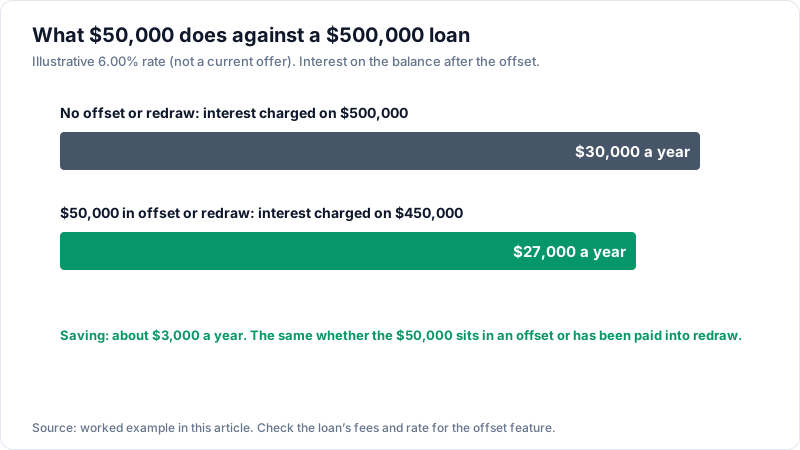
Using an illustrative rate of 6.00% (not a current offer), $50,000 working against a $500,000 loan saves about $3,000 a year in interest, since you pay interest on $450,000 instead of $500,000. That is true whether the $50,000 sits in an offset or has been paid into redraw.
The savings are the same only if the rate is the same. Moneysmart notes that some lenders charge for offset features through a higher interest rate, account fees, or both, so compare the full cost of each loan against the interest you expect to save. Moneysmart also reports that ASIC found some banks failed to apply offsets properly, so interest may be charged without the offset taking effect. Repayments stay the same, so the problem can go unnoticed. Check that your offset is linked, and confirm it again after you refinance or switch loans.
The Tax Trap: The "Purpose Test"
If you live in the home for good, the difference between the two doesn't matter much for tax. If you ever rent the home out, it can matter a lot.
Interest on a loan for an investment property may be tax-deductible, but the ATO looks at the purpose of the borrowing. In simple terms:
- An offset account does not change the loan. The ATO's edited advice on this treats an offset as only a facility to reduce the amount of interest, and notes that putting money in or taking it out does not change the character of the loan interest (ATO edited advice). If you withdraw savings from an offset to buy a car, the loan itself is still the one that bought the property.
- A redraw is treated as a new borrowing. The ATO says interest on redrawn funds is deductible only if the money is used for a deductible purpose. If you redraw for private use, such as a TV and lounge suite, the interest on that part is not deductible. If you redraw to pay a deposit on a rental property, interest on that amount can remain deductible (ATO: Interest expenses).
In practice, redrawing $50,000 for a holiday means part of your loan is now a private loan, and the interest on it will not be deductible. Taking $50,000 out of an offset for the same holiday leaves the original loan untouched.
Mixed Purposes and Record Keeping
If one loan has both a rental part and a private part, the ATO expects you to apportion the interest between them, and the proportions stay in place for the life of the loan. You also cannot repay only the private portion; repayments are split in the same proportion. Keep records showing what each redraw or withdrawal was used for, because you will need them to support what you claim (ATO: Interest expenses).
The ATO also says interest is not deductible for any period the property is used privately, even for a short time, and that borrowing for a new home that does not earn income is not deductible, even if a rental property secures the loan.
Which One Suits You?
- An offset may suit you if you have a large loan, keep a regular savings balance, and want flexible access to your cash. It is also the safer choice if there is any chance you will rent the home out later.
- A redraw may suit you if your balance is mostly "parked" for the long term and the loan has no extra fee for it. Moneysmart notes a redraw facility may suit some people better.
- If your balance is usually low, or the offset loan has a higher rate or fees, compare it against a similar loan without the offset.
Golden rule: if there is any chance you will turn your home into an investment property, think carefully before choosing redraw for money you might later spend on personal items. This page is general information only. Because tax treatment depends on your circumstances, check with a registered tax agent before you rely on it.
Interactive: Offset vs. Redraw Tax Simulator
Planning to rent out your current home eventually? See how pulling cash out of a Redraw for personal use "contaminates" your tax deductions compared to using an Offset.
🪣 Offset vs. Redraw Tax Simulator
See how pulling cash out of a Redraw for a personal purchase "contaminates" your tax deductions.
The Scenario:
You saved $50,000 in your home loan accounts. You decide to take that money out to buy a personal car, and then you rent out the house as an investment property.
The Cost of the Redraw Trap
By using a redraw facility instead of an offset account, you permanently contaminate your investment loan. You will lose $1,035 in tax refunds every single year for the life of the loan.