Fixed vs. Variable Interest Rates (Pros & Cons)
By Dr KH Asadul · Last reviewed 11 October 2026 · General information only, not personal advice
When you take out a mortgage, the bank is lending you money, and the interest rate is the price you pay for that money. In Australia, you must choose how you want that interest rate applied: Fixed or Variable.
Fixed vs. Variable Interest Rates (Pros & Cons)
This decision dictates how much you will pay each month, but more importantly, it determines who takes on the risk if the economy changes.
Variable Rates: The Flexible Option
A variable rate means your interest rate can change at any time, usually in response to the Reserve Bank of Australia (RBA) moving the official cash rate.
- The Pros: Variable loans are highly flexible. You can make unlimited extra repayments to pay down the loan faster, and they almost always allow you to attach a 100% Offset Account. If the RBA cuts interest rates, your monthly repayments will go down.
- The Cons: Uncertainty. If the RBA raises the cash rate (as we saw aggressively throughout 2022 and 2023), your bank will pass that increase on to you, and your monthly repayments will instantly become more expensive.
Fixed Rates: The Certainty Option
A fixed rate "locks in" your interest rate for a set period, typically between 1 and 5 years.
- The Pros: Total budget certainty. Even if the RBA raises interest rates by 2% tomorrow, your monthly repayment will not change by a single cent for the duration of your fixed term. This is excellent for first-home buyers on a tight budget.
- The Cons: Lack of flexibility. Fixed loans usually cap how many extra repayments you can make (the limit varies by lender, so check it before you sign), and they often have fewer features such as an Offset Account. If the RBA cuts interest rates, you are trapped paying the higher fixed rate until your term expires. If you try to break a fixed loan early, the bank will charge you a massive "break fee".
How a Cash Rate Change Reaches Your Loan
The RBA does not set your home loan rate. It sets the cash rate target, which is the interest rate on overnight loans between banks, and each lender then decides its own home loan rates. When the cash rate rises, lenders usually raise their variable rates as well, but how much and how quickly is the lender's choice, so two people with variable loans can see different changes after the same RBA decision. See the RBA's explanation of the cash rate target.
For a variable borrower the effect is direct: a higher rate means a higher repayment on the same loan. For a fixed borrower nothing changes until the fixed term ends, which is the next thing to understand.
The 2026 Context
As at 29 September 2026, the RBA cash rate target is 4.60%, after the Reserve Bank's Monetary Policy Board raised it by 0.25 percentage points that day (RBA statement). Lenders set their own home loan rates, and these do not move one for one with the cash rate, so the rate on your loan will differ from the RBA's number.
Note: the figure above is correct as at 29 September 2026 and can change at any RBA board meeting. Please check the RBA cash rate target page for the current rate before you make a decision.
Fixed and variable rates are sometimes priced close together and sometimes far apart, depending on what lenders expect interest rates to do. When they are close, fixing is less about "beating the bank" and more about asking yourself: Do I value the ability to make extra payments (Variable), or do I value the peace of mind knowing my budget won't blow up (Fixed)? Compare current offers before deciding, and see Moneysmart's guide to fixed vs variable home loan interest rates.
What Happens When Your Fixed Term Ends
A fixed rate is not permanent. When the fixed term ends, the loan usually reverts to the lender's variable rate (the "revert rate"), unless you switch loans or agree to another fixed period. Your repayments could therefore rise on the day the term ends. Moneysmart suggests asking your lender what revert rate would apply and how much your repayments could go up (Moneysmart: fixed vs variable home loan interest rates). Put the end date in your calendar and start comparing offers well before it arrives.
What Breaking a Fixed Loan Can Cost
If you are on a fixed rate loan, you may need to pay a break fee if you switch loans, sell the property or pay off the loan early. Moneysmart does not give a typical amount, because the cost depends on your lender's terms. Lenders generally work it out from the gap between your fixed rate and current rates and how much of the term is left, so the cost can be large if rates have fallen a long way since you fixed. Closing a loan can also trigger a separate discharge fee, which is the fee for closing your current loan (Moneysmart: switching home loans).
Before you fix, ask the lender how break costs are calculated and get an estimate for your loan. Do this before you sign, not after.
The Split Loan (The Best of Both Worlds)
If you can't decide, you don't have to. Most banks allow you to "split" your loan.
For example, on a $600,000 mortgage, you could fix $400,000 for three years to guarantee that portion of your payment won't change, and leave the remaining $200,000 on a variable rate so you can still use an offset account and make extra repayments without penalty.
Questions to Ask Before You Choose
Whatever you decide, Moneysmart suggests asking a lender or broker these questions (Moneysmart: choosing a home loan):
- Can I make extra repayments without a fee?
- Is there an offset account or redraw facility, and do these features carry fees?
- Can I switch to a different loan later?
- Are there break costs if I repay early or refinance?
- What happens when a fixed or introductory rate ends?
- Are there other fees or charges that could apply?
Then compare the comparison rate, which combines the interest rate and most fees into one figure. It does not include every fee, so use it alongside the rest of the loan's Key Fact Sheet rather than on its own (Moneysmart: comparison rate).
Common Mistakes
- Fixing because of a rate forecast. Nobody can reliably predict where interest rates are heading. A better question is how much repayment uncertainty your budget can handle.
- Ignoring the revert rate. The rate you pay after the fixed term ends can be quite different from the one you locked in.
- Budgeting right up to the limit. If your repayment only just fits at today's rate, test it at a higher rate using the simulator below before you commit.
- Choosing on the headline rate alone. Fees and features change the real cost of a loan, which is why the comparison rate and the Key Fact Sheet exist.
- Paying for features you will not use. Features such as an offset account can add cost, and Moneysmart notes an offset may not be worth paying for if your balance is usually low (Moneysmart: pay off your mortgage faster).
- Never checking again. A loan that was competitive when you signed may not be later. Moneysmart's switching home loans guide explains how to check whether switching would save money after costs.
A Worked Example
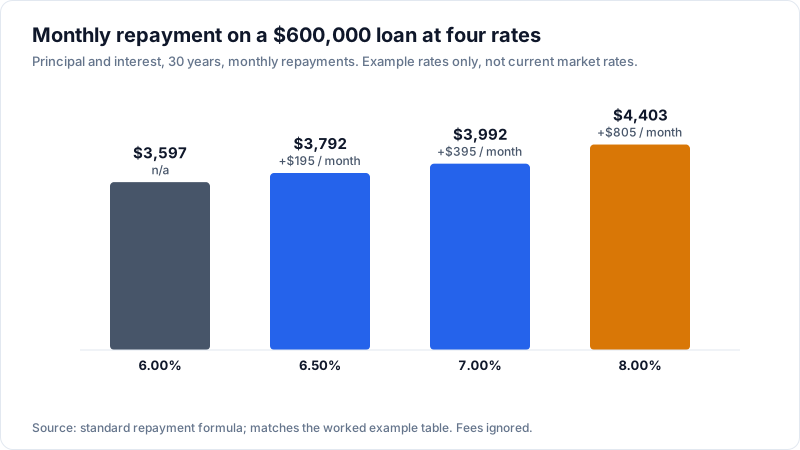
To see why a small rate change matters, take a $600,000 loan over 30 years with principal and interest repayments made monthly. The rates below are examples only, not current market rates.
| Interest rate | Monthly repayment | Extra per month vs 6.00% | Extra per year vs 6.00% |
|---|---|---|---|
| 6.00% | $3,597 | n/a | n/a |
| 6.50% | $3,792 | +$195 | +$2,341 |
| 7.00% | $3,992 | +$395 | +$4,734 |
| 8.00% | $4,403 | +$805 | +$9,663 |
Figures are estimates from the standard repayment formula, rounded to the nearest dollar, and ignore fees. The simulator below uses the same formula.
On a variable loan, a rise from 6.00% to 7.00% adds about $395 a month, or roughly $4,700 a year. If you had instead fixed at 6.00%, your repayment would stay at $3,597 for the fixed term. When that term ends, though, the loan moves to whatever rate applies then, so the increase is delayed, not avoided. You can run your own numbers with the Moneysmart mortgage calculator.
Interactive: Rate Shock Simulator
See how vulnerable your budget is to a rate change. Enter your loan details below to see how a sudden RBA rate hike would impact a variable loan versus a fixed loan.
⚡ Rate Shock Simulator
See how vulnerable your budget is to a sudden RBA rate hike on a variable loan vs. a fixed loan.
The Baseline:
Before the shock, your standard monthly repayment is $3,597.
Because your rate is variable, the bank passes the rate hike straight to you. You must immediately find an extra $805 a month (or $9,663 a year) just to keep your house.
Because you locked your rate in, the RBA hike doesn't affect you. Your budget is safe until your fixed term expires.
Sources and further reading
- RBA: Statement by the Monetary Policy Board, 29 September 2026
- RBA: Cash rate target (current rate and history)
- Moneysmart (ASIC): Fixed vs variable home loan interest rates
- Moneysmart (ASIC): Choosing a home loan
- Moneysmart (ASIC): Switching home loans
- Moneysmart (ASIC): Pay off your mortgage faster
- Moneysmart (ASIC): Mortgage calculator