Lenders Mortgage Insurance (LMI) & Guarantor Loans
By Dr KH Asadul · Last reviewed 11 October 2026 · General information only, not personal advice
The golden rule of Australian real estate is that banks want you to have a 20% deposit. This gives the bank a "buffer." If you stop paying your mortgage and property prices drop, the bank can sell your house and still get all their money back.
Lenders Mortgage Insurance (LMI) & Guarantor Loans
The golden rule of Australian real estate is that banks want you to have a 20% deposit. This gives the bank a buffer: if you stop paying and property prices drop, the bank can sell the home and still recover its money. But saving 20% for a property in Sydney, Melbourne or Brisbane can take years. If you want to buy with a smaller deposit, such as 5% or 10%, the lender will usually charge Lenders Mortgage Insurance (LMI), unless you use a scheme or guarantee that removes the need for it.
The Great LMI Misconception
The most important thing to understand about LMI is that it does not protect you. Moneysmart's definition is blunt: LMI is a safeguard for the lender, it covers the credit provider if a borrower cannot repay, and it does not benefit the borrower, even though the borrower usually pays for it. It is usually a one-time charge when the loan is more than 80% of the property's value (Moneysmart).
How LMI Depends on Your LVR
LMI is based on your Loan-to-Value Ratio (LVR): the loan as a percentage of the property's value. Here is how it works on a hypothetical $700,000 property:
| Deposit | Deposit amount | Loan | LVR | LMI usually needed? |
|---|---|---|---|---|
| 20% | $140,000 | $560,000 | 80% | No |
| 10% | $70,000 | $630,000 | 90% | Yes |
| 5% | $35,000 | $665,000 | 95% | Yes |
The cost rises as your LVR rises, because the lender carries more risk. Premiums vary between lenders and loan sizes, so ask your lender or broker for a quote for your situation rather than relying on a general figure. Many lenders let you add the premium to your loan, which spreads the cost over the loan term but means you pay interest on it. Confirm this with your lender.
Is LMI a Waste of Money?
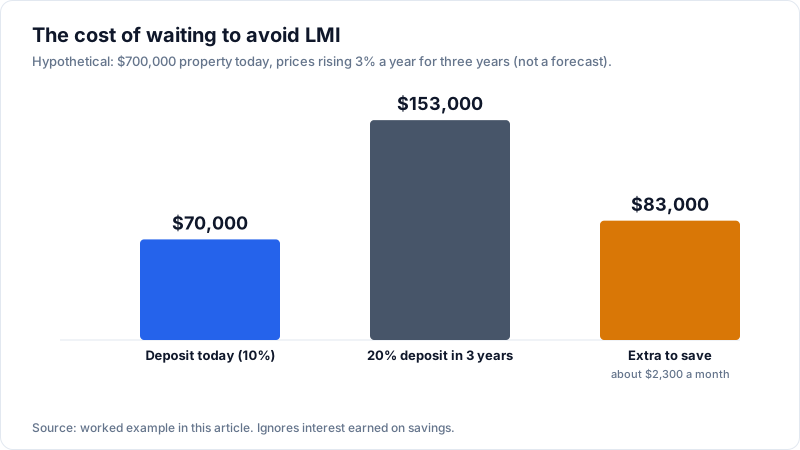
Not necessarily. You have to weigh the cost of LMI against the cost of waiting. Here is a hypothetical example, not a forecast:
- You have a $70,000 deposit (10%) for a $700,000 property today.
- If you wait three years and prices rise 3% a year, the same property costs about $764,900, and a 20% deposit is about $153,000.
- To reach 20% you would need to add roughly $83,000 to your savings, or about $2,300 a month, before any interest earned.
Paying LMI can be the price of buying sooner. But it adds to what you borrow, and prices do not always rise, so this is a personal decision. Run your own numbers with the estimator below.
A Cheaper Way In: The 5% Deposit Scheme
The federal government's 5% Deposit Scheme, formerly the Home Guarantee Scheme, lets eligible buyers purchase with a deposit as low as 5% and avoid some LMI costs. From 1 October 2025, Treasury says places are uncapped, income caps were removed, and property price caps were raised (Treasury). The Prime Minister's announcement says the scheme is open to all first home buyers, with the government guaranteeing a portion of your loan so you can avoid some LMI costs (PM).
- The General Stream covers first home buyers and those who have not owned property in the last 10 years, with a deposit as low as 5%.
- The Single Parent Stream allows a deposit as low as 2% for eligible single parents or guardians with a dependent.
- Price caps vary by location, so check the current cap for the area you want to buy in.
Moneysmart also lists Help to Buy, a shared equity scheme that needs a minimum 2% deposit and a participating lender, where the government can contribute up to 30% of the price of an existing home or up to 40% of a new home. It is not a grant: the government keeps a share of the property's value and is repaid when you sell or buy back its interest. Several states offer their own low-deposit loans and shared equity schemes as well (Moneysmart).
Note: scheme rules, caps and availability are correct as at 11 October 2026 and can change. Please check Treasury or Housing Australia for current eligibility and price caps before you plan around them.
The Alternative: The Guarantor Loan
If you want to buy with a small deposit but avoid LMI, a guarantor loan is another option. A family member, usually a parent, uses part of their own property as security for your loan. The guarantee may cover only part of the loan, such as the deposit shortfall. In a simple example, you put in a 5% deposit and your parents guarantee another 15%, so the lender sees the loan as 80% of the combined security.
- The catch: Moneysmart's warning is that the guarantor must pay if you cannot repay. That puts their own home at risk. If they are close to retirement, that risk matters even more.
- Get legal advice: Moneysmart advises independent legal advice before anyone signs. The guarantor and the borrower should each understand the terms, ideally with separate advice.
- Lender policies differ: Whether a lender waives LMI, how much of the loan a guarantee can cover, and how a guarantor can later be released all depend on the lender. Ask in writing before you commit. Releasing a guarantor often involves your equity growing or refinancing, but there is no guarantee that a lender will agree.
Questions to Ask Before You Decide
- What would LMI cost at my deposit and loan size, and can it be added to the loan?
- Am I eligible for the 5% Deposit Scheme or a state scheme, and what is the price cap where I want to buy?
- If I use a guarantor, what exactly is guaranteed, and how can they be released?
- What would my repayments be if interest rates rose?
Interactive: LMI vs. Waiting Estimator
Is it better to pay LMI now or keep saving? Adjust the property price and your current deposit below to see the estimated LMI fee, compared to how much the property might rise in value while you wait.
⚖️ LMI vs. Waiting Estimator
Is it cheaper to pay Lenders Mortgage Insurance now, or wait and save a 20% deposit?
It is cheaper to pay LMI and buy now.
Paying $25,900 in LMI today is cheaper than paying an extra $180,345 for the property while you wait 50 months to save a 20% deposit.